
Packaging Insights
For businesses, the goal should be to choose packaging that uses materials efficiently while still providing the strength and functionality required for the product. Right-sized paper bags, kraft paper packaging, and suitable paper-based gift packaging can help reduce unnecessary material use while maintaining practical product presentation.
For businesses, the goal should be to choose packaging that uses materials efficiently while still providing the strength and functionality required for the product. Right-sized paper bags, kraft paper packaging, and suitable paper-based gift packaging can help reduce unnecessary material use while maintaining practical product presentation.
This guide covers what businesses should know before switching to or expanding their use of eco-friendly paper packaging, from material basics to sourcing considerations.
Quick Takeaways
✔ Paper-based packaging is generally more recyclable than plastic alternatives
✔ Not all “eco-friendly” claims are equally meaningful — look for specifics
✔ FSC certification supports responsibly sourced paper
✔ Reducing excess material matters as much as material choice
✔ Eco-conscious packaging increasingly influences customer perception
✔ Sourcing from a reliable supplier ensures consistent sustainability standards
Why Eco-Friendly Paper Packaging Matters for Businesses
Paper-based packaging can offer several environmental advantages when the material is sourced responsibly and designed with its end use in mind. Paper is generally recyclable, can be made from renewable resources, and can be reused in many packaging applications. However, simply choosing a paper-based product does not automatically make a packaging solution sustainable. Factors such as material sourcing, coatings, unnecessary layers, packaging size, durability, and end-of-life options also matter.
Businesses comparing paper with plastic can also consider the differences between paper gift bags and plastic bags, particularly in terms of recyclability, reuse, material sourcing, and everyday gifting applications.
Beyond perception, paper-based packaging generally offers genuine environmental advantages over plastic alternatives, particularly around recyclability and the use of renewable materials — making it a rare case where doing right by the environment and meeting customer expectations point in the same direction.
What Makes Paper Packaging Eco-Friendly
Not all paper packaging is equally sustainable, so businesses should look beyond the basic fact that a package is made from paper. The material used, how it is manufactured, whether it contains plastic-based coatings, how much material is required, and what happens to it after use can all influence its overall environmental impact.
One commonly used option is kraft paper, which is valued for its strength and versatility across retail and gifting applications. Businesses can learn more about kraft paper bags, their uses, benefits, and applications before selecting them for specific packaging needs.
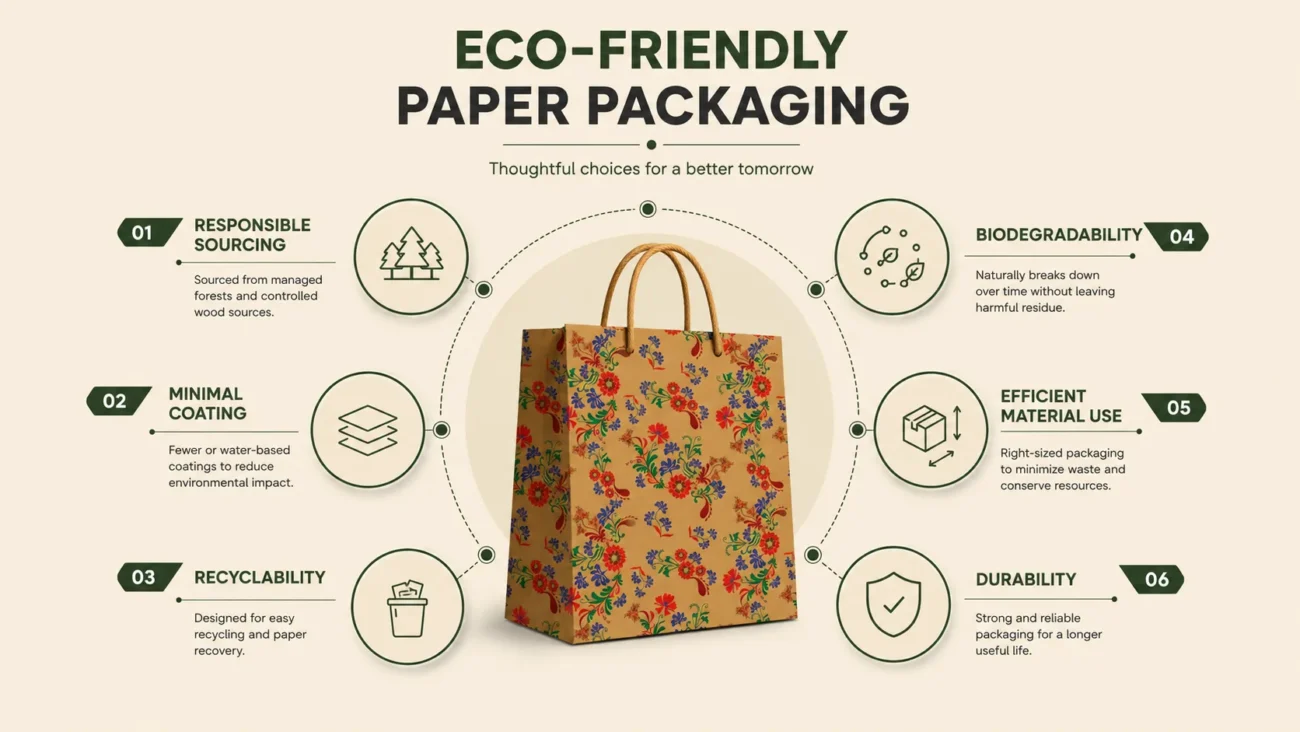
When evaluating eco friendly paper packaging, businesses should consider the following factors:
- Responsible material sourcing — Paper sourced from responsibly managed forests or containing recycled content can support more responsible resource use. Where relevant, businesses can also look for recognized certifications that provide information about the source of the paper.
- Minimal plastic coating or lamination — Paper with heavy plastic-based coatings or lamination’s can be more difficult to process through conventional paper recycling systems. Where the application allows, simpler paper-based construction can make end-of-life recycling more straightforward.
- Recyclability — Packaging that can enter established paper recycling systems has the potential to be processed into new paper products. However, actual recyclability can depend on the material composition and local recycling infrastructure.
- Biodegradability — Paper generally breaks down more readily than many synthetic packaging materials, particularly when it is minimally treated. However, businesses should distinguish between biodegradable packaging and recyclable packaging, as these describe different end-of-life characteristics.
- Efficient use of material — Sustainability is not only about the type of material used. Choosing an appropriately sized bag or box and avoiding unnecessary layers, excess filler, or oversized packaging can help reduce overall packaging waste.
- Durability and useful life — Packaging that is too weak for its intended application may tear, collapse, or need to be replaced. Choosing paper packaging with suitable strength helps prevent unnecessary material use and product damage.
The choice also depends on how the packaging will be used, since different types of paper gift bags offer different formats, sizes, handle styles, and presentation options.
Ultimately, eco friendly paper packaging should be evaluated as a complete packaging choice rather than simply by its appearance or the word “eco-friendly” on a product description. Businesses that consider sourcing, construction, material efficiency, durability, and end-of-life options can make more informed packaging decisions.
Sustainable Paper Packaging vs Plastic Packaging
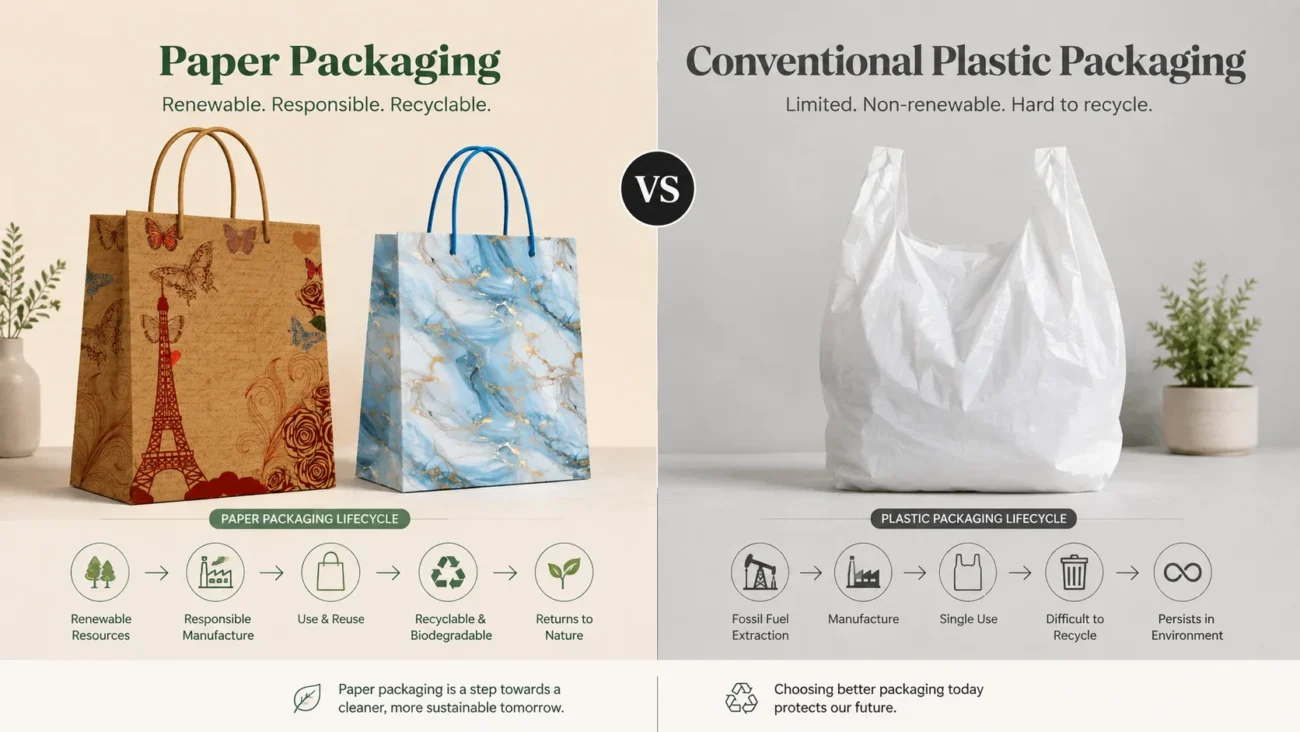
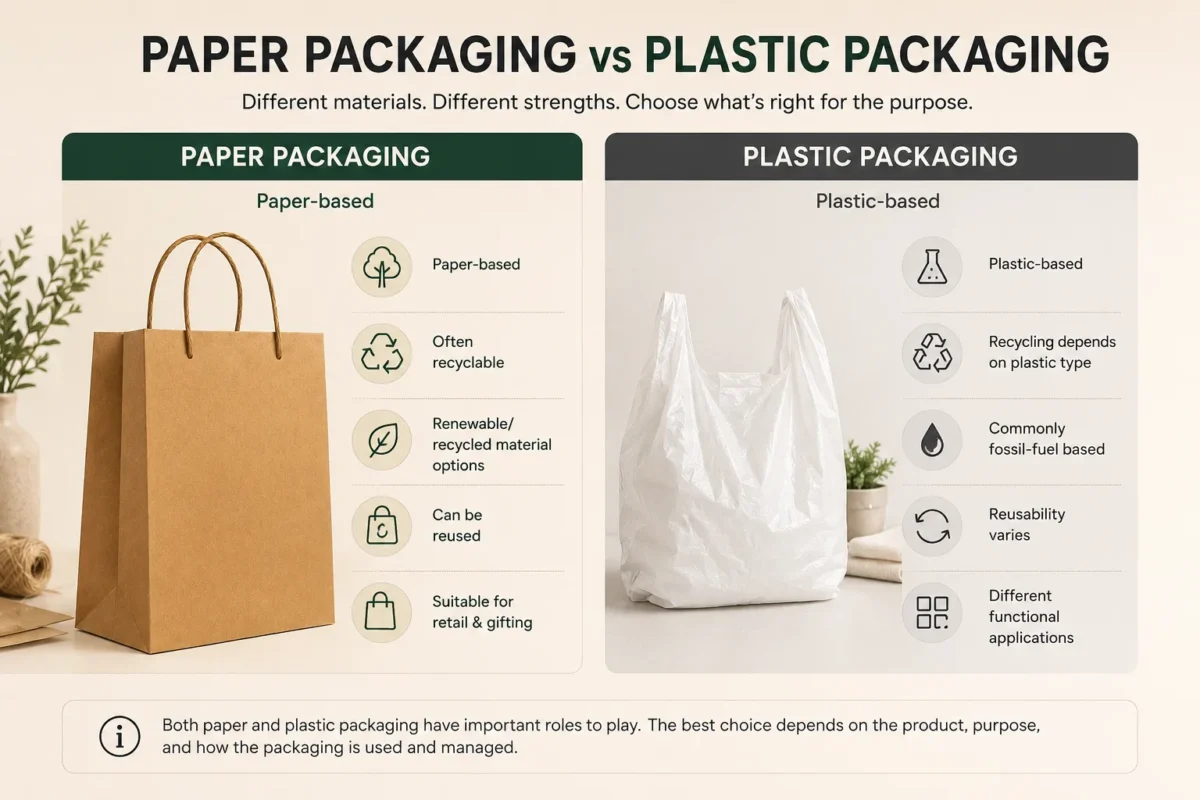
Choosing between paper and plastic packaging requires businesses to consider more than the material itself. Factors such as recyclability, sourcing, durability, re-usability, and the intended application all affect whether a particular packaging option is suitable. For many retail and gifting applications, sustainable paper packaging can provide a practical paper-based alternative to conventional plastic packaging.
| Factor | Sustainable Paper Packaging | Plastic Packaging |
|---|---|---|
| Recyclability | Often recyclable through paper recycling systems, depending on coatings and local infrastructure | Depends heavily on the type of plastic and available recycling facilities |
| Biodegradability | Paper generally breaks down more readily, particularly when minimally treated | Most conventional plastics do not biodegrade readily |
| Material sourcing | Can use renewable or recycled paper resources | Commonly produced from fossil-fuel-based raw materials |
| Reusability | Sturdier paper bags and boxes can often be reused | Reusability varies considerably by product type |
| Packaging waste | Right-sized paper packaging can help reduce unnecessary material use | Excess plastic packaging can create longer-lasting waste |
| Common applications | Retail bags, gift bags, gifting, wrapping, and paper-based packaging | Useful for applications requiring specific moisture, flexibility, or barrier properties |
Businesses specifically comparing these two options can also explore the advantages and differences between paper gift bags and plastic bags for gifting and retail applications.
However, this does not mean that paper is automatically the better choice for every application. Businesses should select packaging according to the product, handling conditions, required durability, and end-of-life options.
For eco friendly paper packaging, the strongest approach is to consider the complete packaging life-cycle: use an appropriate amount of material, avoid unnecessary coatings where possible, choose packaging that performs reliably, and consider what happens to it after use.
For retail and gifting businesses, this can make paper bags, kraft packaging, and other paper-based formats a practical choice where their characteristics meet the requirements of the product.
Recyclable Paper Packaging: What to Know
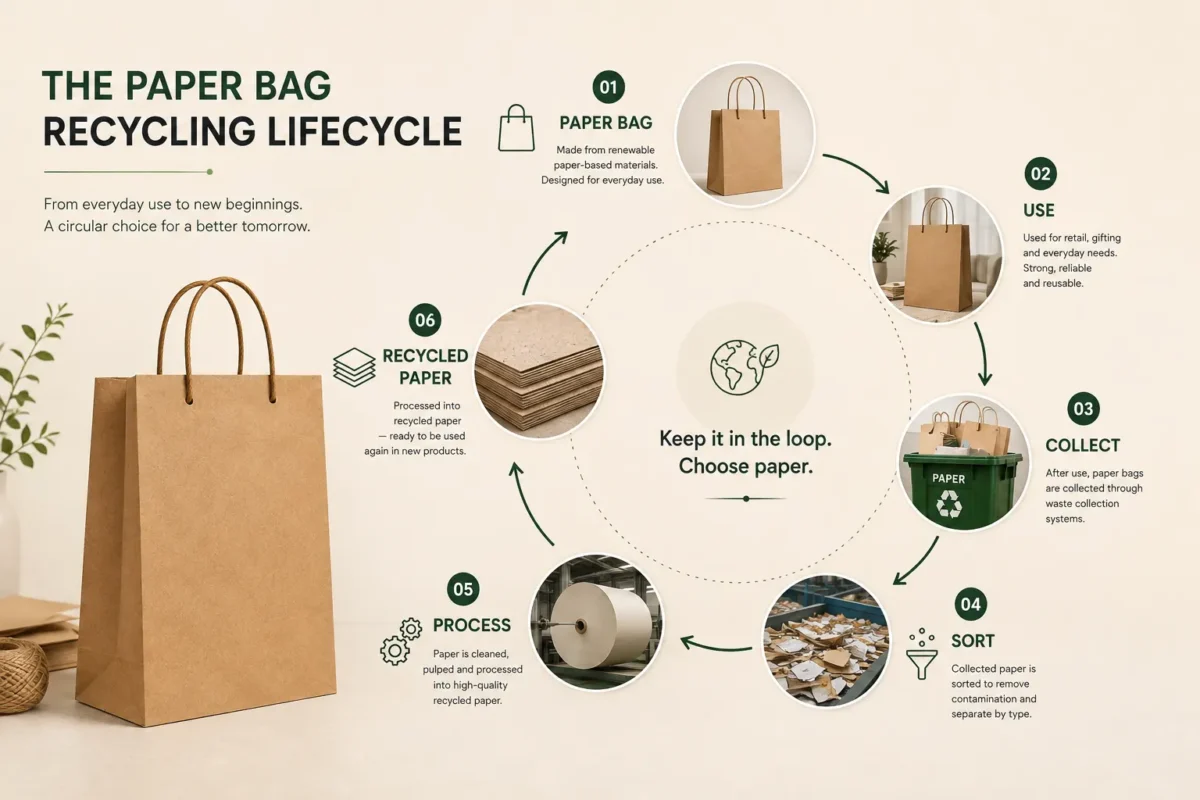
Recyclable paper packaging is one of the key reasons businesses consider paper-based alternatives, but recyclability depends on more than the material simply being paper. The type of paper, coatings, lamination’s, contamination, and local recycling infrastructure can all affect whether packaging can be effectively processed after use.
Businesses evaluating recyclable packaging should consider the following:
- Uncoated or lightly finished paper — Paper packaging with fewer non-paper coatings is generally easier to process through conventional paper recycling systems.
- Laminated paper — Some laminated paper products may still be recyclable through specific systems, but plastic-based coatings or layers can make processing more complicated than with simpler paper packaging.
- Clean packaging — Paper contaminated with food, liquids, grease, or other substances may not be accepted through the same recycling streams as clean paper. Businesses should therefore consider the likely use of the packaging when assessing its recyclability.
- Local recycling infrastructure — Recycling capabilities vary by location. A packaging material may technically be recyclable but still have limited practical recycling options in a particular area.
- Material composition — Businesses should understand whether handles, coatings, adhesives, windows, or other components are made from materials that could affect the recycling process.
- Efficient material use — Choosing an appropriately sized bag or box can reduce unnecessary material consumption in the first place. Recyclability is important, but reducing avoidable packaging waste is also part of a more responsible packaging strategy.
For businesses, the best approach is to ask specific questions about the material and its end-of-life options rather than relying only on broad terms such as “green” or “eco-friendly.” Clear information about paper composition, coatings, and disposal can help businesses make more informed eco friendly paper packaging decisions.
Biodegradable Paper Packaging Explained
Biodegradable paper packaging is often considered a practical option for businesses looking to reduce their reliance on materials that persist in the environment for long periods. Paper is generally capable of breaking down naturally, particularly when it has been minimally processed and does not contain extensive plastic-based coatings or other non-paper components.
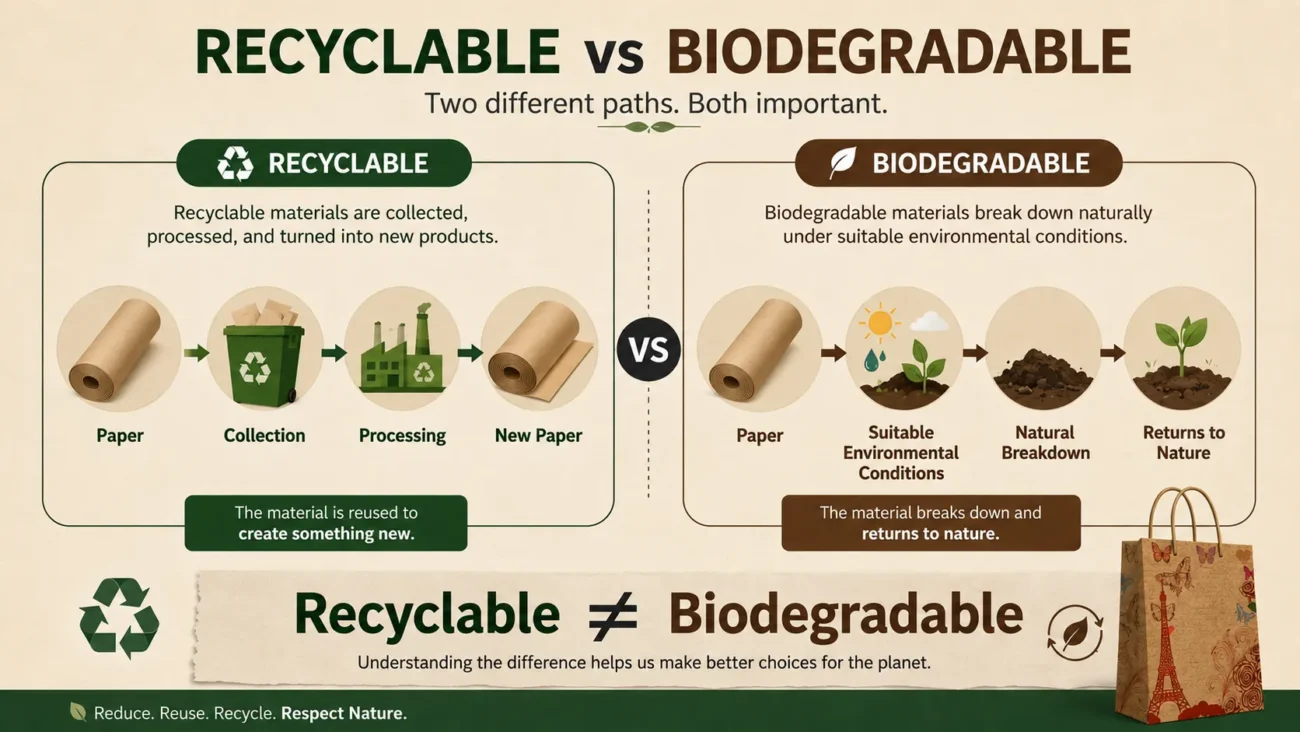
However, businesses should understand that biodegradability and recyclability are not the same thing. A packaging material may be recyclable, biodegradable, or potentially both, depending on its composition and how it is treated.
When evaluating biodegradable paper packaging, consider the following:
- Paper composition — Kraft paper and other minimally processed paper materials generally break down more readily than heavily coated or laminated paper products.
- Coatings and finishes — Plastic-based lamination’s, coatings, or other non-paper layers can affect how quickly a paper product breaks down and may also influence its recyclability.
- Biodegradable does not mean instantly degradable — Paper still requires appropriate environmental conditions to break down. Businesses should avoid presenting biodegradable packaging as something that disappears immediately after disposal.
- Recycling and biodegradability serve different purposes — If clean paper packaging can be recycled, recycling may keep the material in use for longer. Biodegradability is more relevant to what happens when material reaches an environment where it can naturally decompose.
- Composting considerations — Some paper packaging may be suitable for composting, but this depends on its specific material composition, coatings, inks, adhesives, and the requirements of the relevant composting system.
- End-of-life information matters — Businesses communicating sustainability benefits should provide accurate information about how their packaging should be reused, recycled, composted, or disposed of.
For businesses considering eco friendly paper packaging, biodegradability should therefore be viewed as one part of the overall sustainability picture. Material sourcing, packaging efficiency, durability, recyclability, and end-of-life handling all contribute to making a more informed packaging choice.
Paper Based Packaging Materials and Certifications
Choosing the right paper based packaging material involves looking beyond the simple fact that a product is made from paper. Paper type, recycled content, sourcing practices, strength, coatings, and intended use can all influence whether a particular packaging option is suitable for a business.
- Kraft Paper: Kraft paper is widely used for bags and other paper-based packaging because of its strength and practical construction. It can be suitable for retail, gifting, and everyday carrying applications where durability and a paper-based format are important.
When evaluating kraft packaging, businesses should consider the paper weight, construction, finish, and intended load rather than assuming that every kraft paper product offers the same performance. - Recycled Paper: Recycled paper incorporates recovered paper fibers into the manufacturing process, helping reduce reliance on virgin fiber for the portion of material made from recycled content. Its suitability depends on the required strength, finish, and application.
For businesses, recycled content can be one factor to consider when evaluating the overall environmental profile of a packaging product. - Recycled Kraft Paper: Recycled kraft paper combines the characteristics of kraft paper with recycled content. It can be considered for businesses looking for paper-based packaging that incorporates recovered material while still meeting practical requirements for strength and handling.
As with other packaging materials, businesses should check the actual recycled content and product specifications rather than assuming that every product described as recycled contains the same proportion of recycled material.
Businesses evaluating kraft packaging can also explore the uses, benefits, and applications of kraft paper bags across retail, gifting, and other everyday packaging needs. - FSC Certified Paper: FSC certified paper provides a way for businesses to identify paper sourced through a recognized forest-management certification system. FSC certification can support more informed responsible sourcing decisions by providing information about the origin and management of the forest-based material.
However, certification should be considered alongside other factors such as packaging construction, material efficiency, coatings, durability, and end-of-life options.
Businesses can also compare different types of paper gift bags and their practical uses when deciding which paper-based format best suits their products. Ultimately, choosing sustainable paper packaging is not about selecting one material based on a single label. Businesses should consider the full combination of material source, construction, intended use, durability, and disposal or recycling options before making a packaging decision.
Sustainable Packaging Solutions for Different Business Needs
Sustainable packaging solutions are not one-size-fits-all. The right packaging depends on the type of business, the products being packaged, how the packaging will be handled, and the level of presentation required. Rather than selecting packaging simply because it is described as sustainable, businesses should choose a paper-based option that performs reliably for its intended application while using materials efficiently.
Different business types may have different requirements:
- Retail businesses — Kraft paper bags and other paper gift bags can provide a practical option for everyday customer purchases. The appropriate bag size, paper strength, handle construction, and design should be selected according to the products being carried.
For retailers looking to make paper bags part of their everyday packaging process, a guide to choosing paper gift bags for retail businesses can help with considerations such as size, usability, stock planning, and presentation. - Gifting businesses — Decorative paper bags and suitable paper-based gift boxes can support product presentation while keeping the packaging format consistent with a paper-based approach. Ready-made designs can also simplify packaging selection when businesses need readily available options.
- Food and bakery businesses — Paper packaging can be suitable for certain food-related applications, but businesses should select materials specifically designed and approved for the intended food-contact use rather than assuming that every paper product is suitable.
- Corporate gifting programs — Paper-based bags and boxes can support larger gifting programs where businesses need consistent packaging across multiple recipients. Selecting a manageable range of packaging formats can also make storage, distribution, and preparation easier.
- Small businesses and local retailers — Choosing a few versatile paper packaging formats instead of maintaining a large number of specialized options can help reduce unnecessary stock and simplify day-to-day packaging operations.
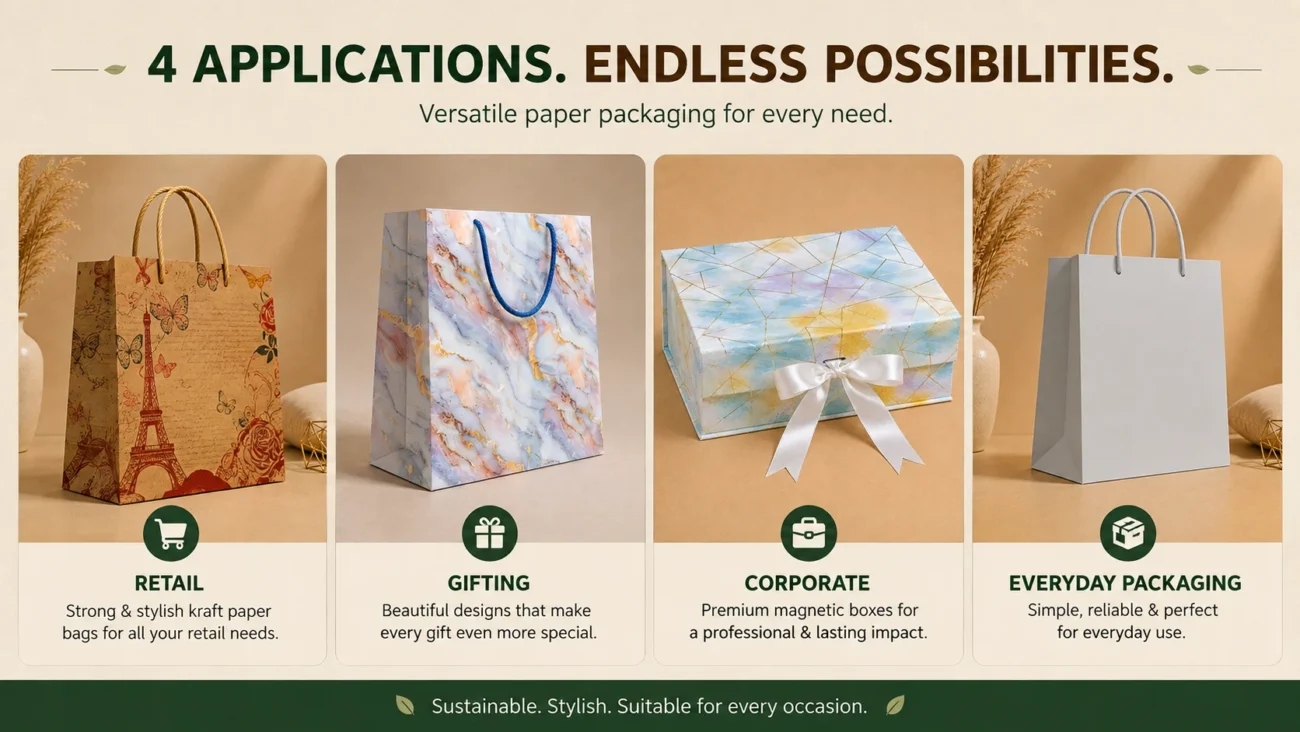
The most suitable sustainable packaging solution is therefore one that balances material choice, durability, size, functionality, presentation, and end-of-life considerations. Businesses can make more responsible packaging decisions by evaluating these factors together rather than focusing on sustainability as a single product feature.
Eco-Friendly Packaging for Businesses: Practical Considerations
Adopting eco friendly packaging for businesses involves more than simply replacing one material with another. Businesses also need to consider how much packaging is required, whether it is strong enough for its intended use, how consistently it can be sourced, and what happens to it after use. A practical approach helps ensure that sustainability considerations do not come at the expense of packaging performance or create unnecessary material waste.
Businesses should consider the following:
- Right-size the packaging — Choose a bag or box that provides enough space for the product without leaving excessive empty space. This can reduce unnecessary material use and make storage and handling more efficient.
Getting the size and material balance right can also help businesses avoid common gift packaging mistakes related to sizing, protection, and material selection. - Match packaging strength to the product — Packaging that is too weak can tear, collapse, or require replacement. Selecting an appropriate paper weight, construction, or box structure helps the packaging perform reliably throughout handling and distribution.
- Review material and supplier information — Businesses should understand what materials are being used and, where relevant, ask suppliers about sourcing practices, recycled content, certifications, coatings, and other material specifications.
- Consider the complete packaging format — The paper itself is only one part of the product. Handles, adhesives, coatings, lamination’s, labels, and other components can also influence recycling and end-of-life considerations.
- Avoid unnecessary packaging layers — Extra wrapping, oversized boxes, excessive filler, or packaging components that do not serve a practical purpose can increase overall material use.
- Plan for storage and distribution — Packaging should be practical to store and handle before it reaches the customer. Foldable or space-efficient formats can be useful for businesses managing larger packaging inventories.
- Communicate sustainability claims accurately — Businesses should avoid broad statements such as “100% eco-friendly” unless they can substantiate them. Specific information about recyclable materials, recycled content, certifications, or responsible sourcing is more useful and credible.
- Review packaging periodically — As product ranges, order volumes, and customer expectations change, businesses should reassess whether their current packaging sizes, materials, and quantities remain appropriate.
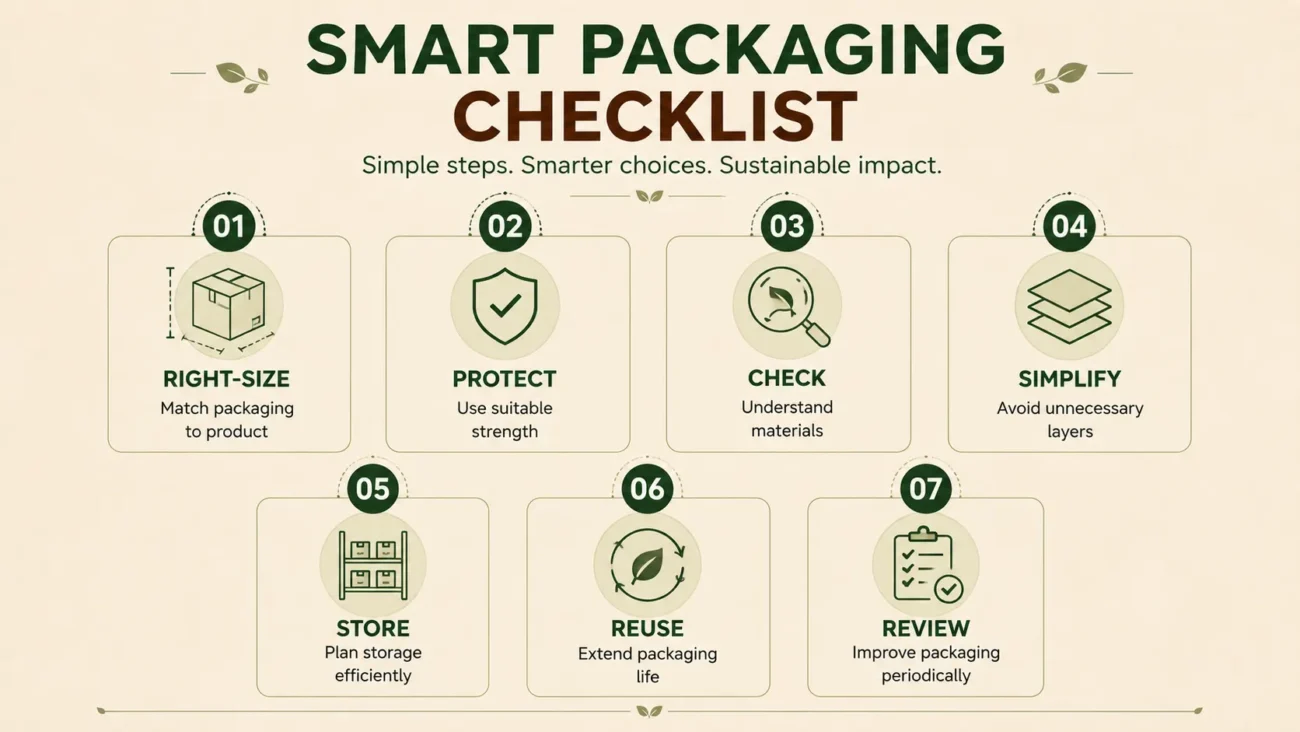
A successful approach to sustainable packaging for businesses is therefore about balancing environmental considerations with practical performance. The most suitable option is one that protects the product, uses materials efficiently, fits the business’s operational requirements, and provides a realistic end-of-life pathway.
Sourcing Eco-Friendly Paper Packaging
Businesses looking to source eco friendly paper packaging should evaluate more than the material itself. The supplier, available product range, packaging construction, order quantities, and consistency across orders can all affect whether a packaging choice works effectively for day-to-day business use.
When comparing an eco friendly packaging supplier or paper packaging manufacturer, consider the following factors:
- Understand the material used — Ask whether the packaging is made from kraft paper, other paper stocks, or recycled paper content, depending on the product and application.
- Check the finish and construction — Paper packaging with unnecessary plastic-heavy coatings or finishes may be less straightforward to recycle than simpler paper-based alternatives. Consider the actual construction rather than relying only on an “eco-friendly” label.
- Choose the right packaging size — Oversized bags and boxes use more material than necessary. Selecting a suitable size for the product can help reduce unnecessary packaging waste.
- Consider durability — Sustainable packaging still needs to perform its intended function. A paper bag or box that tears, collapses, or needs to be replaced immediately can create additional material waste.
- Check available quantities — Businesses purchasing packaging for retail, gifting, or seasonal requirements should confirm whether the supplier can provide the required quantity and product sizes consistently.
- Review product variety — A supplier offering different paper-based packaging formats can make it easier to select the right option for different products and occasions.
- Ask clear questions about sustainability claims — If a supplier describes packaging as recyclable, biodegradable, or responsibly sourced, businesses should look for specific information supporting the claim rather than relying on broad environmental language.
For businesses purchasing sustainable paper bags wholesale or other paper packaging in larger quantities, it is particularly important to check availability before placing an order. Seasonal demand, retail requirements, and corporate gifting programs can all increase packaging requirements at short notice.
Planning quantities in advance also gives businesses more time to compare available sizes, designs, materials, and packaging formats rather than choosing whatever is immediately available. Businesses can also explore kraft paper bags for retail and gifting applications to understand their common uses, benefits, and practical applications.

Eco-Friendly Packaging and Customer Perception
Packaging is one of the first physical elements customers interact with when they receive a product. For businesses using eco friendly packaging, the material, appearance, and overall presentation can influence how customers perceive the company’s approach to sustainability.
However, the strongest customer response usually comes from packaging choices that are practical, consistent, and supported by genuine material decisions, rather than sustainability claims alone.
A few factors are particularly important:
- Eco-conscious consumers — Customers who actively consider environmental factors may pay attention to whether packaging is paper-based, recyclable, reusable, or unnecessarily layered with other materials.
- Visible material choices — Kraft paper bags, paper boxes, and other paper-based formats can make the material choice immediately noticeable, particularly when the packaging has a simple and functional construction.
- Clear and accurate communication — If a business communicates that its packaging is recyclable or made from a particular paper material, the claim should accurately reflect the product and its disposal requirements.
- Consistency across packaging — Using sustainable packaging occasionally while relying heavily on less sustainable alternatives elsewhere can make sustainability messaging feel inconsistent. A more consistent packaging approach is easier for customers to understand.
- Practical presentation — Sustainability should not come at the expense of packaging performance. A bag that cannot safely carry the product or a box that becomes damaged during handling can create a negative experience regardless of its material.
- Reuse and continued use — Sturdy paper bags and boxes may be reused by recipients for storage or future gifting, extending their practical usefulness beyond the original purchase.
Businesses should also avoid treating sustainability as purely a marketing message. The actual packaging materials, construction, sizing, and end-of-life options should support whatever environmental claims are communicated. Packaging can influence more than environmental perception; how packaging influences customer experience also depends on presentation, usability, protection, and the overall unboxing process.
For example, reducing unnecessary packaging material can be a practical sustainability improvement even when a business is not changing its entire packaging range at once.
This makes sustainability a combination of material choice, efficient packaging design, durability, and responsible communication rather than simply adding an “eco-friendly” label.

Common Mistakes in Sustainable Packaging Choices
Choosing paper-based packaging is a step toward more responsible packaging, but the material alone does not guarantee a sustainable result. Businesses can still make avoidable mistakes when selecting, sourcing, using, or communicating about sustainable packaging.
Some of the most common mistakes include:
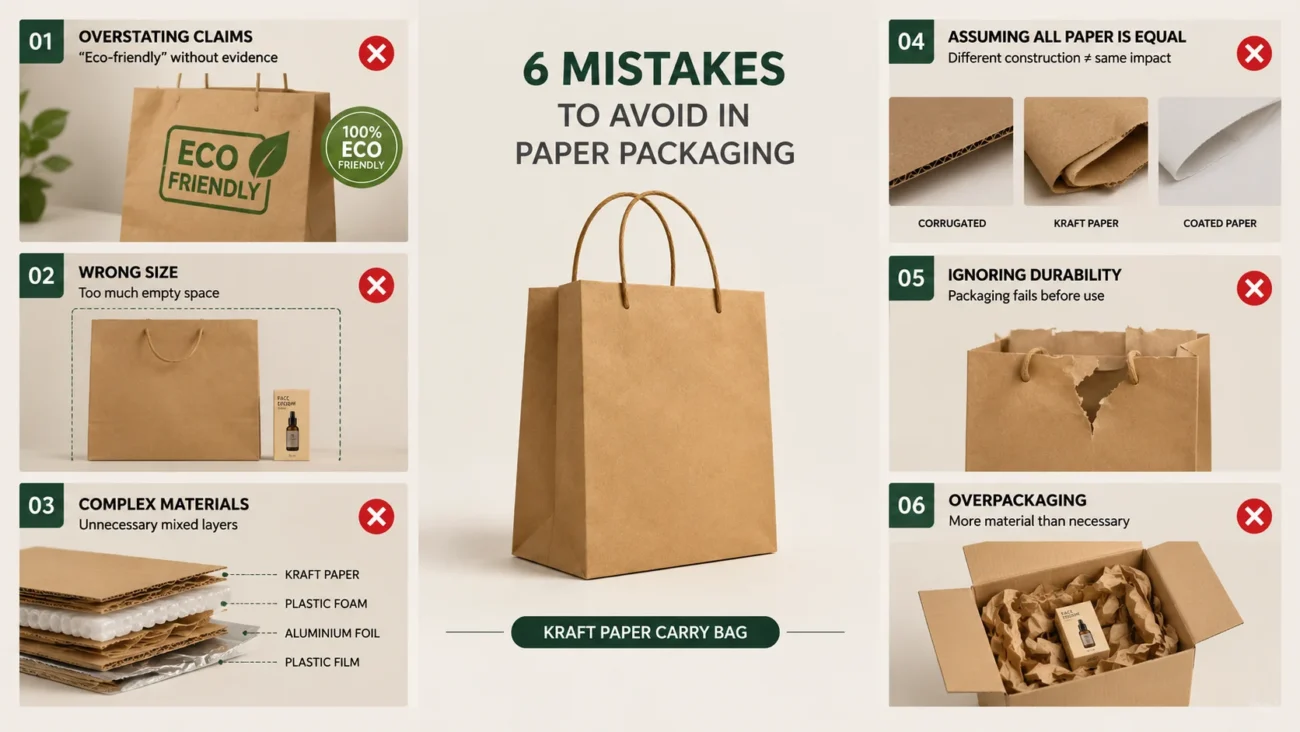
- Overstating “eco-friendly” claims — Describing packaging as sustainable without explaining what makes it so can create confusion and weaken customer trust. Businesses should communicate specific, accurate information about materials, recyclability, or reuse where relevant.
- Ignoring packaging size — Choosing boxes or bags that are significantly larger than the product can increase material consumption and unnecessary packaging waste. Right-sizing packaging is one of the simplest ways to improve material efficiency.
- Mixing materials that complicate recycling — Paper packaging combined with excessive plastic coatings, non-paper components, or difficult-to-separate materials may make recycling less straightforward. Businesses should consider the complete construction of the packaging rather than looking only at its paper content.
- Assuming all paper is equally sustainable — Paper packaging can differ in its sourcing, recycled content, thickness, coatings, and overall construction. Businesses should evaluate these factors rather than treating every paper product as environmentally equivalent.
- Overlooking durability — Packaging that tears, collapses, or becomes unusable before it has served its purpose can result in replacement packaging and additional material consumption. Sustainability should therefore be considered alongside the packaging’s intended use and required strength.
- Using more packaging than the product requires — Multiple layers of bags, boxes, wrapping, and filler may create unnecessary material use when a simpler packaging format would provide adequate protection and presentation.
- Choosing packaging without considering its actual end use — A packaging material may appear environmentally preferable but still be unsuitable if it cannot safely carry, protect, or present the product. Selecting the right format for the application helps prevent premature replacement and waste.
For many businesses, even relatively simple changes — such as choosing appropriately sized paper bags, reducing unnecessary packaging layers, and selecting durable paper-based formats — can contribute to a more efficient packaging system.
Why Choose Gift-N-Greet
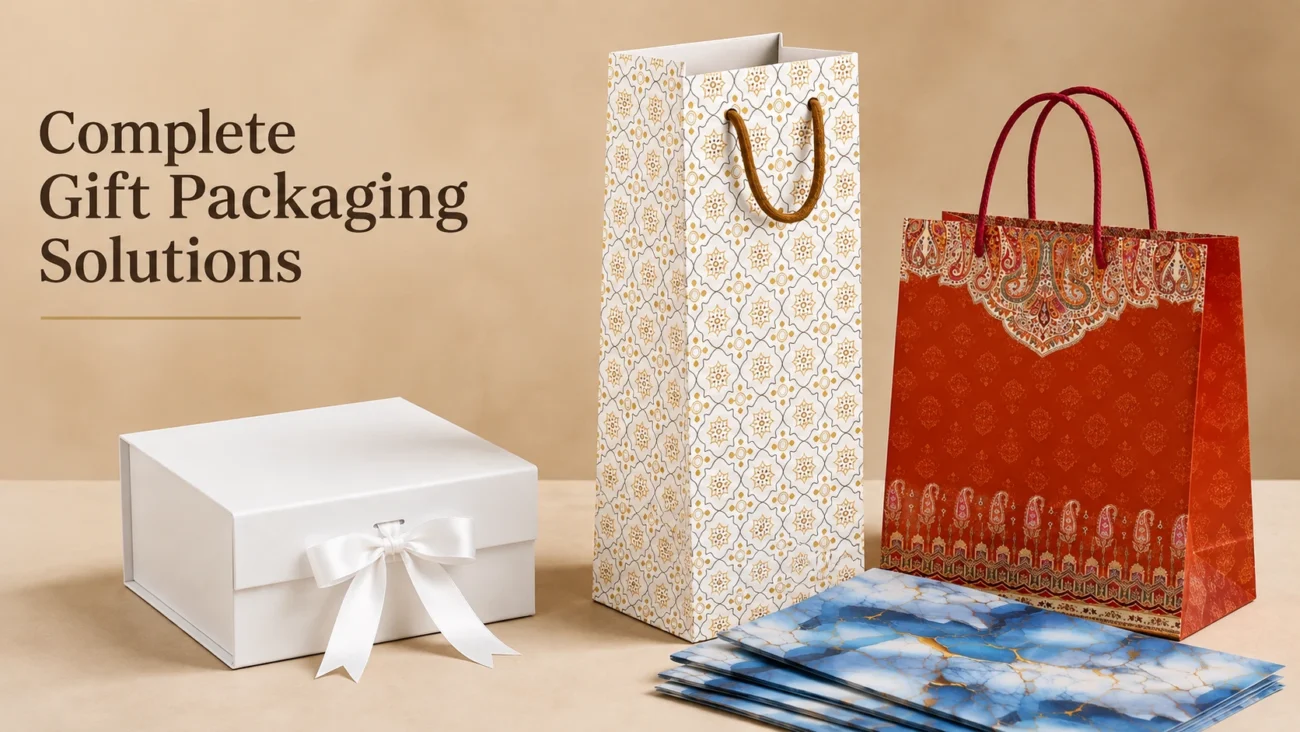
GiftNGreet is a paper packaging manufacturer based in New Delhi, offering a range of ready-made packaging products for retail, gifting, and business requirements. The current range includes Kraft Paper Carry Bags, Decorative Paper Carry Bags, Solid Color Paper Carry Bags, Foldable Magnetic Lid Boxes, and Wrapping Paper.
For businesses looking to use more paper-based packaging, having access to different ready-made formats makes it easier to select packaging according to the product, occasion, size, and presentation requirements. Paper carry bags can work well for retail and gifting, while foldable magnetic lid boxes provide a structured option for selected gift items.
GiftNGreet focuses on producing and supplying these packaging formats with consistent product specifications and presentation, helping businesses plan their regular and seasonal packaging requirements more efficiently.
Whether you are sourcing paper bags for retail, festive gifting, or business requirements, you can explore the available packaging range and select the format that best suits your application.
Explore GiftNGreet Packaging
Frequently Asked Questions
Eco friendly paper packaging generally uses paper-based materials that can be recycled, reused, or biodegraded depending on their construction and local waste-management systems. Responsible material sourcing, appropriate sizing, minimal unnecessary coatings, and good durability can also contribute to a more sustainable packaging choice.
No. Many paper-based packaging products can be recycled, but recyclability depends on the material, coatings, additional components, contamination, and local recycling facilities. Businesses should check the actual construction of their packaging rather than assuming that every paper product has the same end-of-life options.
Recyclable packaging can be collected and processed into new paper-based materials, while biodegradable packaging can break down naturally under suitable conditions. These are different properties, and a packaging product may be recyclable, biodegradable, or both depending on its material and construction.
FSC certification indicates that the paper comes from sources managed according to the standards of the Forest Stewardship Council. For businesses prioritizing responsible sourcing, checking whether a particular paper product has relevant certification can provide more specific information than relying on general sustainability claims.
Pricing varies according to the paper type, product size, construction, quantity, and supplier. Businesses purchasing in larger quantities can often evaluate different ready-made packaging options to find a practical balance between material choice, durability, presentation, and cost.
Businesses can reduce packaging waste by selecting appropriately sized bags and boxes, avoiding unnecessary layers, limiting excess filler, and choosing packaging that is durable enough for its intended use. Efficient packaging can reduce material consumption without requiring a complete change in the packaging format.
Look for clear information about materials, consistent product quality, suitable packaging sizes, reliable availability, and transparent communication about sustainability-related claims. For bulk purchases, businesses should also confirm quantities and delivery timelines before placing an order.
The answer depends on the specific construction, but kraft paper with minimal additional coating is generally easier to recycle and biodegrade than paper heavily combined with plastic-based lamination. Businesses should evaluate the complete material rather than comparing products based only on their names.
GiftNGreet supplies paper-based packaging products, including kraft paper carry bags and other paper gift packaging, for business and retail requirements. Businesses can review the available range and contact the company to discuss product availability and bulk requirements.
Related Reading
- Kraft Paper Bags: Uses, Benefits & Applications
- Paper Gift Bags vs Plastic Bags: Which Is Better?
- Types of Paper Gift Bags Explained
- Packaging Ideas for Corporate Gifting
Manufactured in New Delhi
Packaging Designed For Every Occasion
Explore GiftNGreet’s collection of gift boxes, paper gift bags, wrapping paper, and packaging solutions suitable for gifting, retail businesses, celebrations, and everyday presentation.
Looking for packaging solutions? Visit our Contact Us page for retail and bulk enquiries.