
Packaging Insights
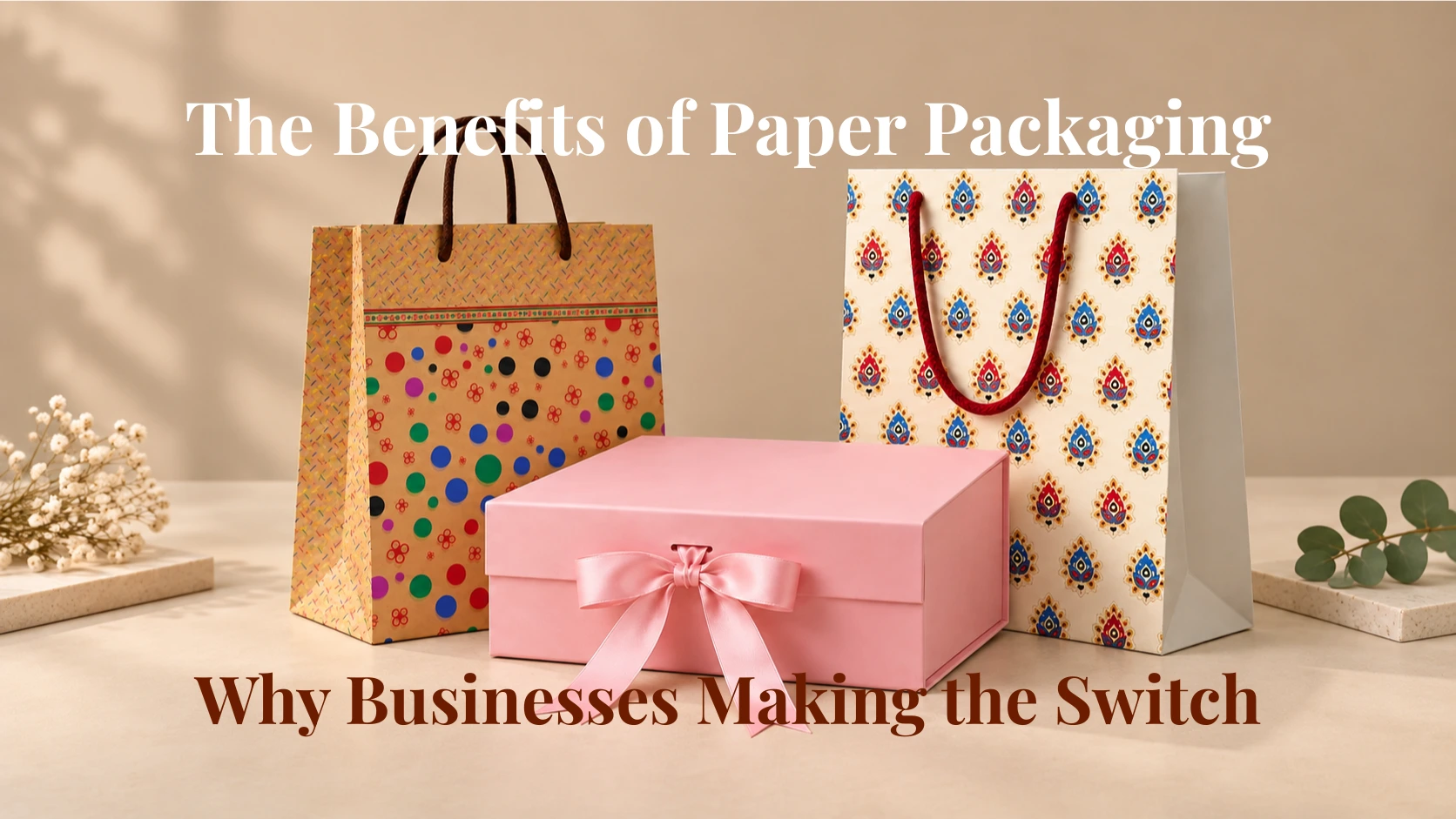
Ask a shop owner why they moved from plastic bags to paper, and the first answer is often, “We had to.” Then, a few minutes later, a second answer might come out: “But honestly, customers like it better.” Both answers help explain the shift. The benefits of paper packaging go beyond regulation or sustainability. They include customer perception, product presentation, reuse, and practical day-to-day performance.
Understanding these factors helps businesses decide where paper makes sense and where another material may still be more suitable. This guide explores why businesses prefer paper packaging, where it offers practical advantages over plastic, and where plastic may still be the more appropriate option.
The Short Version
- Plastic carry bag regulations in India have encouraged many businesses to consider alternative packaging.
- Paper packaging can support a more considered and organized product presentation.
- Paper provides a suitable surface for printing, patterns, and different finishes.
- Recyclability depends on the paper, coatings, construction, and local recycling facilities.
- Paper is less suitable for some wet products and applications requiring a strong moisture barrier.
- The best results come from matching the paper type, weight, and construction to the intended use.
Why Businesses Are Asking This Question Now
A few years ago, packaging was rarely a topic that came up in everyday business discussions. Today, businesses may reconsider their packaging because of changing regulations, customer feedback, or the packaging choices made by competitors. For some retailers, the priority is finding an alternative to plastic carry bags. For others, it is improving how products are presented or choosing packaging that better suits their customers and business operations.
The useful question is not simply whether paper is better than plastic. It is which material works best for the products you sell, the way you operate, and the customers you serve.
A gift shop may value appearance and presentation, while a business selling products that need moisture protection may have different requirements. Looking at packaging in this context makes it easier to compare the available options and make a practical decision.
Benefit 1: Paper Fits Where Regulation Is Heading
Regulation is one reason businesses in India have reconsidered their use of plastic packaging. The Plastic Waste Management (Amendment) Rules, 2021 introduced restrictions on specified single-use plastic items from 1 July 2022. The rules also increased the minimum thickness requirement for plastic carry bags to 120 microns from 31 December 2022, subject to the applicable provisions and exemptions. Two points are particularly relevant for business owners.
Carry bags are a common packaging requirement. Retail shops, gift stores, and other businesses regularly use carry bags to help customers transport their purchases. This makes the choice of bag material an important operational consideration.
Requirements and enforcement need to be checked locally. Applicable rules can depend on the product, material, relevant exemptions, and local enforcement. Businesses should verify the current requirements for their state or city before making a packaging decision.
Paper bags can provide an alternative to restricted plastic carry bags, but switching to paper does not automatically establish compliance with every packaging regulation. Businesses should check the rules relevant to their specific products and packaging applications. The practical benefits of paper packaging is that choosing an appropriate paper-based alternative can help businesses reduce their reliance on certain types of plastic carry bags while supporting their day-to-day packaging needs.
Editorial note: Recheck the current regulatory details against official sources before publishing, particularly the applicable exemptions and any subsequent amendments.
Benefit 2: Customers Notice, and Usually Approve
One benefits of paper packaging is the way it can contribute to a product’s overall presentation. A well-constructed paper bag with suitable handles can make a purchase feel organized and ready to carry, particularly when the product is intended for gifting.
Several factors contribute to this effect.
- Product presentation: A properly sized paper bag can help a purchase look organized rather than simply packed for transport.
- Gifting suitability: Paper bags and boxes are practical options when customers intend to present their purchases to someone else.
- Reuse: A sturdy bag may be kept for carrying other items, depending on its construction and condition.
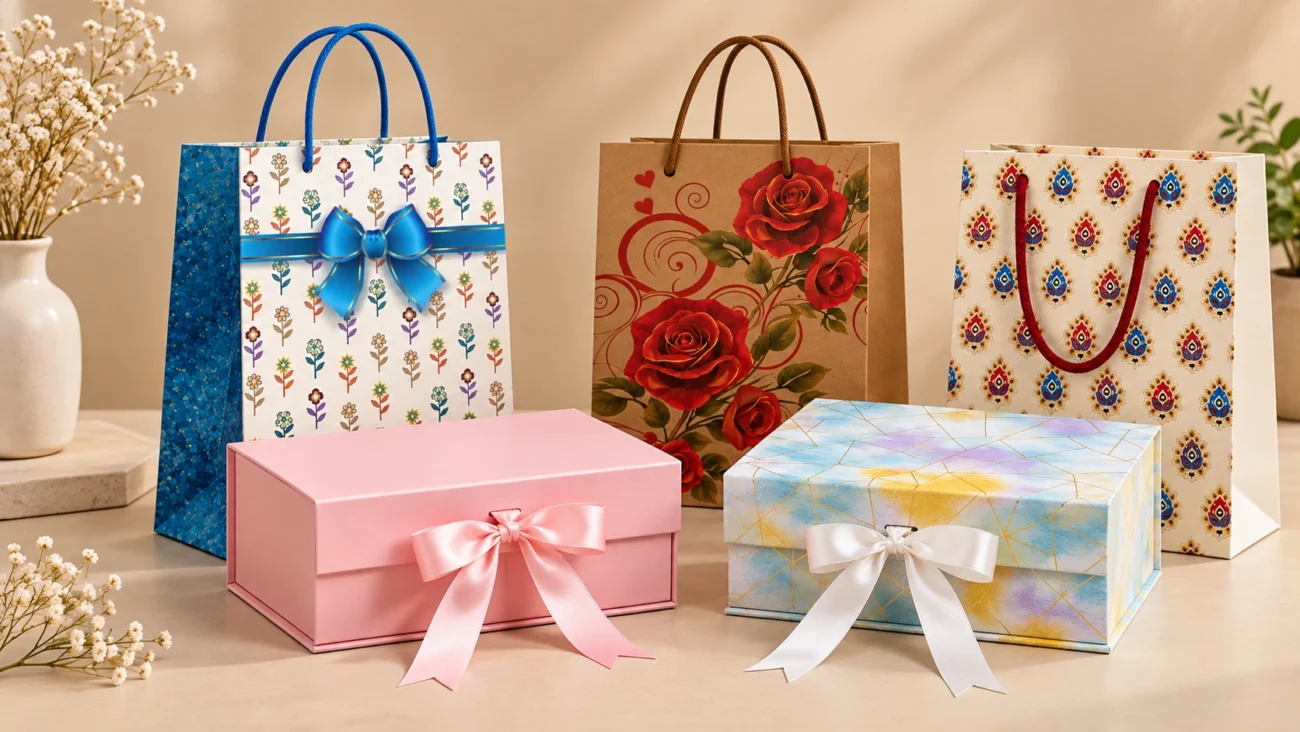
- Visual consistency: Businesses can use coordinated bag styles, colors, and printed patterns to create a consistent appearance across purchases.
These benefits do not mean that every customer will choose a shop because it uses paper packaging. Rather, packaging can contribute positively to the overall buying experience, particularly when presentation is already important to the business.
For gift shops and retailers, the choice of bag can therefore serve a purpose beyond carrying a product. It can help maintain a consistent presentation from the counter to the customer.
Businesses looking to improve this aspect can also explore how gift packaging influences first impressions and product presentation.
Benefit 3: Sustainable Paper Packaging, Without the Hype
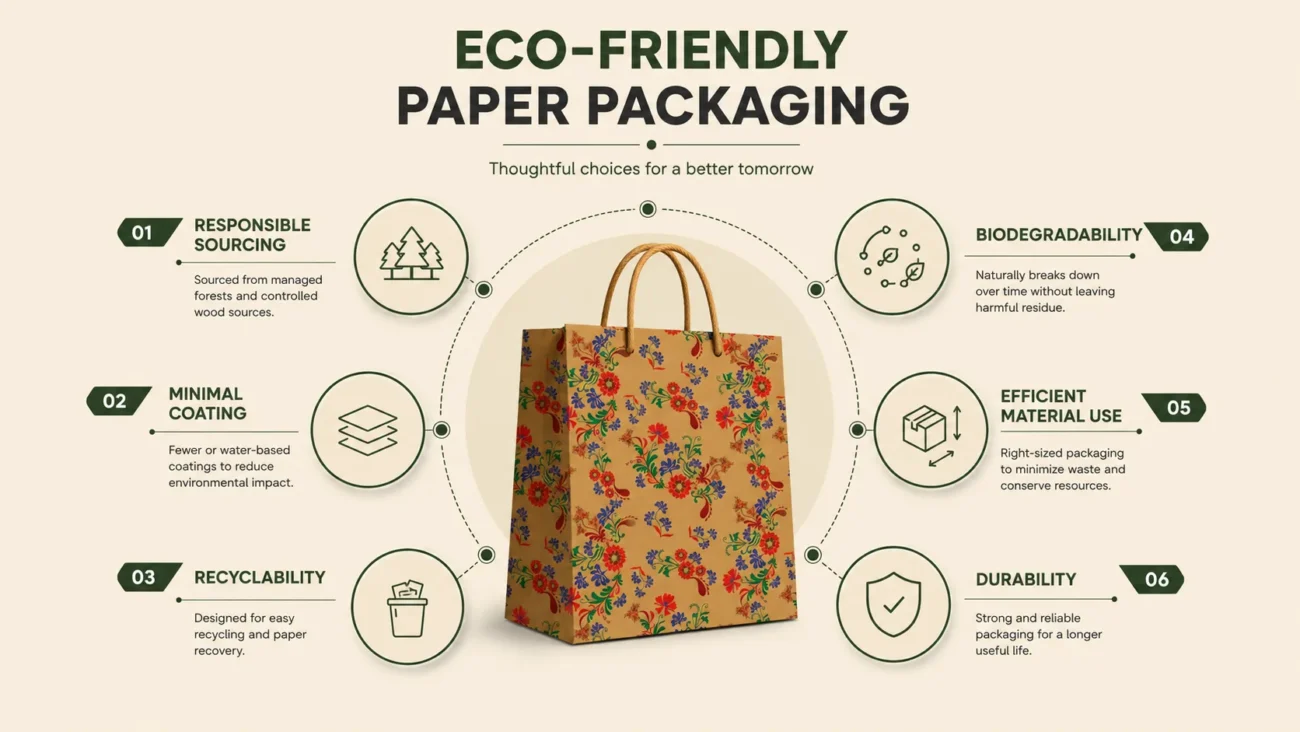
Sustainable paper packaging is often one of the first reasons businesses consider switching from plastic. Paper can offer environmental advantages, but those advantages depend on how the packaging is made, used, and disposed of.
Here are four benefits of paper packaging worth considering:
- Recyclability: Clean, uncoated paper is generally suitable for paper recycling streams where facilities are available. Lamination, coatings, adhesives, and mixed materials can make recycling more difficult.
- Renewable raw material: Paper is made from plant-based fibres. However, the environmental impact also depends on how those fibres are sourced and how the material is manufactured.
- Biodegradability: Uncoated paper can break down under suitable environmental conditions, but the rate depends on factors such as moisture, temperature, and the surrounding environment.
- Reuse: A sturdy paper bag that is used multiple times provides more uses from the same item than a bag discarded after one trip.
The important point is that paper packaging is not automatically sustainable simply because it is made from paper. Its environmental impact depends on the material, construction, durability, reuse, and end-of-life options.
For example, a heavily laminated paper bag may be harder to recycle than a plain paper bag. Similarly, a bag that tears after one use may offer less practical value than a durable bag that can be reused.
Businesses discussing sustainability should therefore describe their packaging accurately rather than relying on broad claims such as “completely eco-friendly.” For a more detailed explanation of these factors, read what businesses should know about eco-friendly paper packaging.
Benefit 4: Paper Does More of the Visual Work
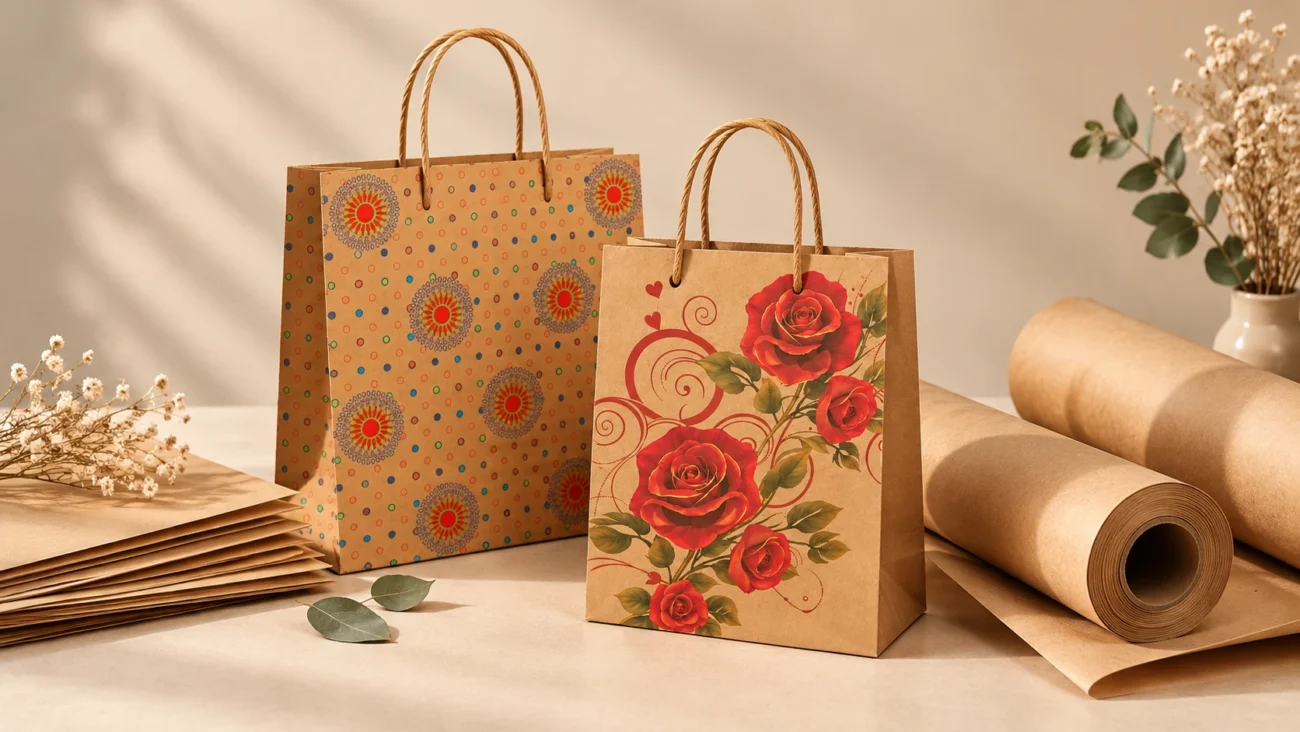
Plastic bags are often chosen primarily for their carrying function. Paper packaging can serve that purpose while offering more options for visual presentation.
- Printing: Paper provides a suitable surface for colors, patterns, illustrations, and other printed details.
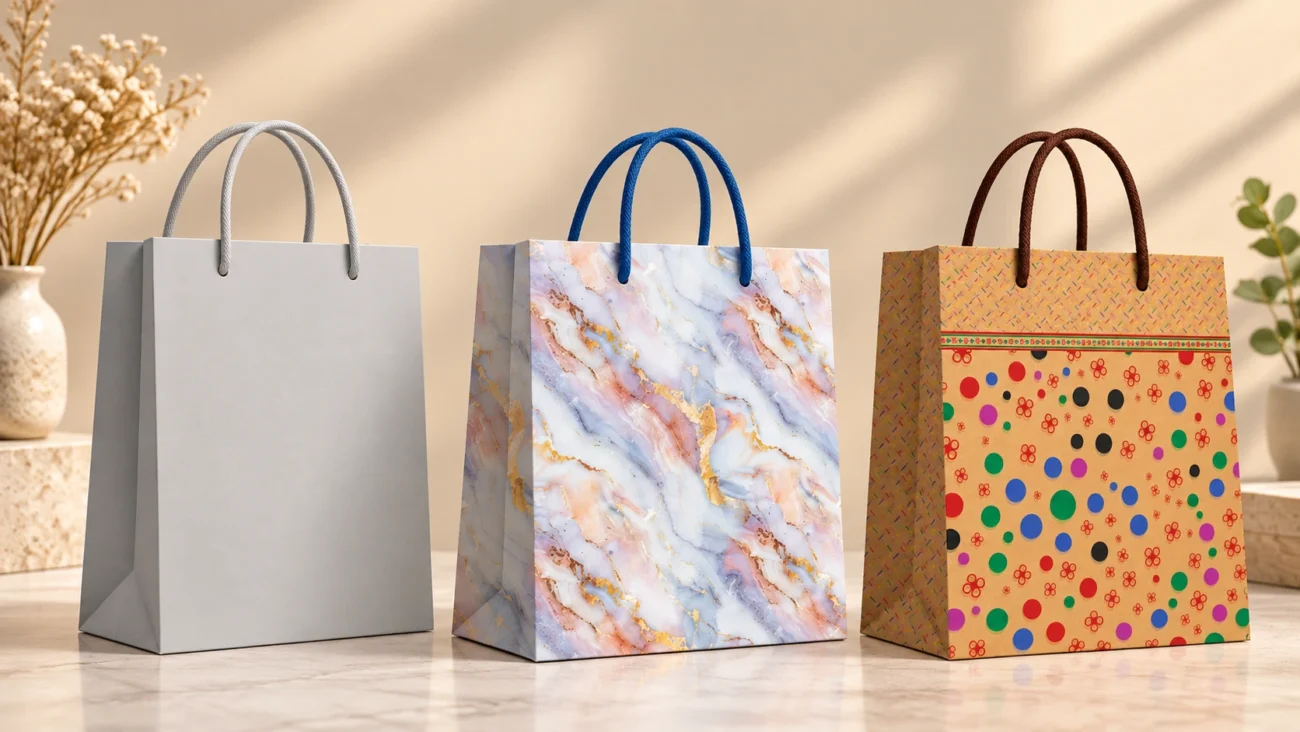
- Finishes: Natural kraft, plain solid colors, and different surface treatments create different appearances.
- Structure: Properly constructed paper bags can hold their shape, while boxes provide defined edges and a more organized way to present products.
- Photography: Paper bags and boxes can be presented effectively in product photographs, retail displays, and social media content.
For businesses where presentation matters, these features can be particularly useful. Gift shops may prefer decorative bags, while boutiques may choose solid-color bags to maintain a consistent appearance across purchases.
The benefit is not simply that paper looks better than plastic in every situation. Rather, paper gives businesses more flexibility in how they present products and organize their packaging range. That flexibility is especially relevant for gift shops, boutiques, festive retail, and corporate gifting, where the packaging often forms part of the customer’s overall experience.
Benefit 5: Strength and Reuse When It’s Made Properly
A common assumption is that plastic is always stronger than paper. In practice, strength depends on the material specifications, construction, and intended use of each package.
Several factors determine how well a paper bag performs.
- Paper weight (GSM): GSM measures paper weight per square metre. It is an important specification, but it does not determine strength on its own. Paper type and construction also matter.
- Construction: A reinforced base and securely attached handles can help a bag carry its intended load more reliably.
- Handle design: Rope handles and other suitable handle types can provide comfortable carrying when properly attached and matched to the bag’s intended load.
- Reuse: A durable paper bag may be used again for carrying purchases or storing items, provided its condition remains suitable.
The bottom reinforcement and handle attachment deserve particular attention because these areas can experience significant stress during use. A bag made from heavier paper can still fail if its adhesive joints or handles are poorly constructed.
For businesses buying bags in quantity, the best approach is to evaluate the complete benefits of paper packaging rather than relying on paper weight or appearance alone. Test a sample with the types of items customers normally carry and check whether the bag remains stable during handling. The key takeaway is that paper packaging can be strong enough for many retail applications when its material, dimensions, and construction are matched to the intended load.

Paper Packaging vs Plastic Packaging: A Fair Comparison
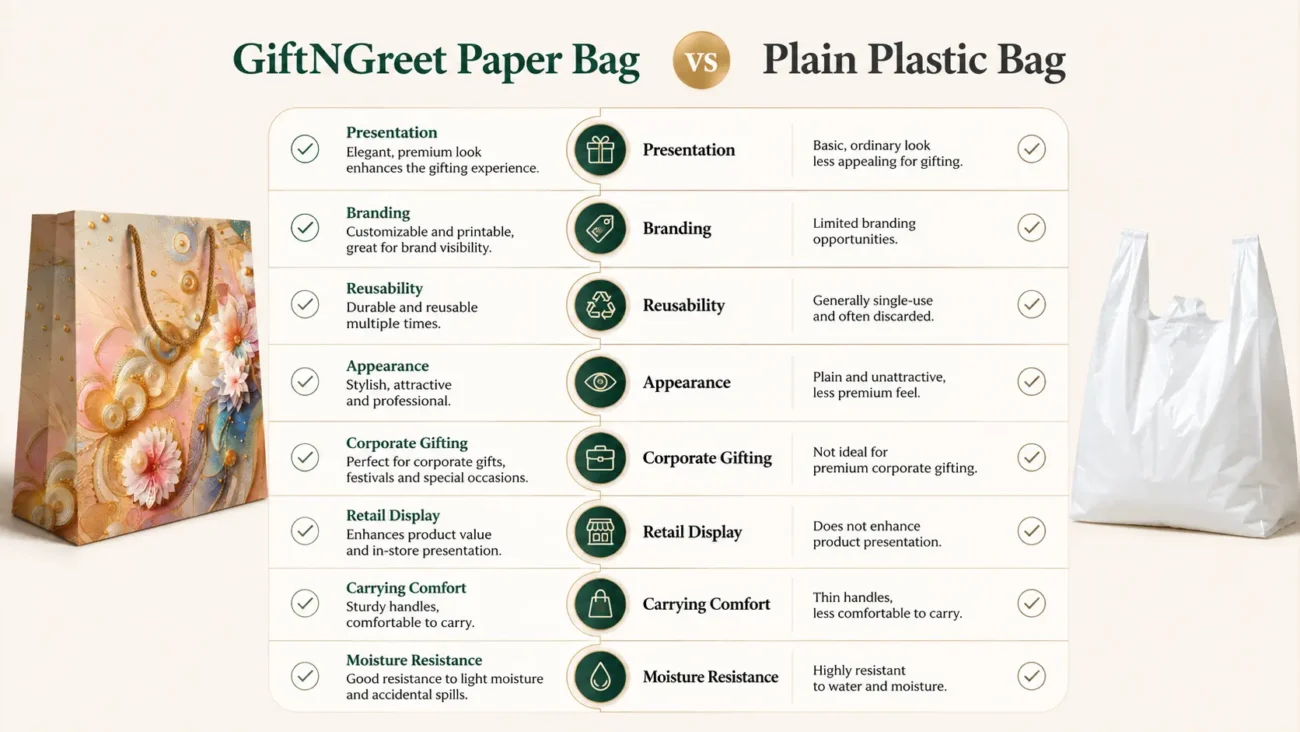
Paper and plastic packaging each have advantages. The right choice depends on the product, the conditions in which it will be carried or stored, the required presentation, and the overall cost.
| Factor | Paper Packaging | Plastic Packaging |
|---|---|---|
| Regulatory considerations in India | An alternative for many carry-bag applications | Restrictions apply to specified items; requirements vary by product and applicable rules |
| Recyclability | Often suitable for recycling when clean and appropriately constructed | Depends on plastic type and available recycling facilities |
| Printing and presentation | Offers a range of colors, patterns, and finishes | Can be printed, but options vary by material and format |
| Moisture resistance | Generally weaker unless appropriately treated | Often better suited to moisture-sensitive applications |
| Carrying loads | Depends on paper weight, construction, and reinforcement | Depends on material thickness and construction |
| Customer perception | Often associated with retail presentation and gifting | Often selected for functional packaging requirements |
| Reusability | Sturdy bags may be reused several times | Reuse depends on the bag’s construction and condition |
| Cost per unit | Can cost more than very thin plastic bags | Can be economical for certain high-volume applications |
The comparison shows why businesses should evaluate the benefits of paper packaging according to its intended use rather than assuming one material is always better.
Where Plastic Still Makes More Sense:
It would be misleading to suggest that paper is the right choice for every application. Plastic can remain practical in situations such as:
- Moisture-sensitive applications: Certain wet products and delivery conditions require greater resistance to water.
- Sealed-barrier packaging: Some products need packaging that provides a barrier against moisture, contamination, or other external factors.
- Cost-sensitive utility applications: In some high-volume applications, a plastic format may offer a lower unit cost or better functional performance.
The decision should account for applicable regulations, product requirements, handling conditions, and disposal options. The objective is to choose the material that performs the required job while meeting relevant requirements.
Kraft Paper Packaging: The Practical Middle Ground
Kraft paper packaging is a practical option for businesses looking for straightforward paper-based packaging. It is commonly used for shopping bags, retail carry bags, gift bags, and other applications where a simple appearance and suitable construction are important.
Here is why businesses often consider kraft paper:
- Practical construction: Kraft paper is commonly used for bags that need to withstand everyday handling, although actual strength depends on paper specifications and construction.
- Simple appearance: Its natural brown color provides an understated look that works across many retail settings.
- Versatility: Kraft bags can be used for shopping purchases, gifting, events, and other suitable applications.
- Different cost options: Plain kraft formats may be less expensive than some heavily printed or finished alternatives, depending on specifications and order quantities.
- Easy to coordinate: Kraft bags can be paired with tissue paper, tags, or other simple finishing details when additional presentation is required.
For small businesses, starting with one or two suitable kraft bag sizes can be a practical way to evaluate the benefits of paper packaging before expanding the range. However, kraft paper should not automatically be described as more sustainable than every alternative. Its environmental impact still depends on sourcing, construction, use, and end-of-life handling.
Businesses comparing options can explore kraft paper bags for everyday retail and business packaging to understand how this format may fit their requirements.
Paper Bags for Businesses: Matching the Bag to the Business
Paper bags for businesses work best when the format matches the products being sold and the way customers carry them. Different businesses have different packaging requirements here are some benefits of paper packaging for different kinds of businesses.
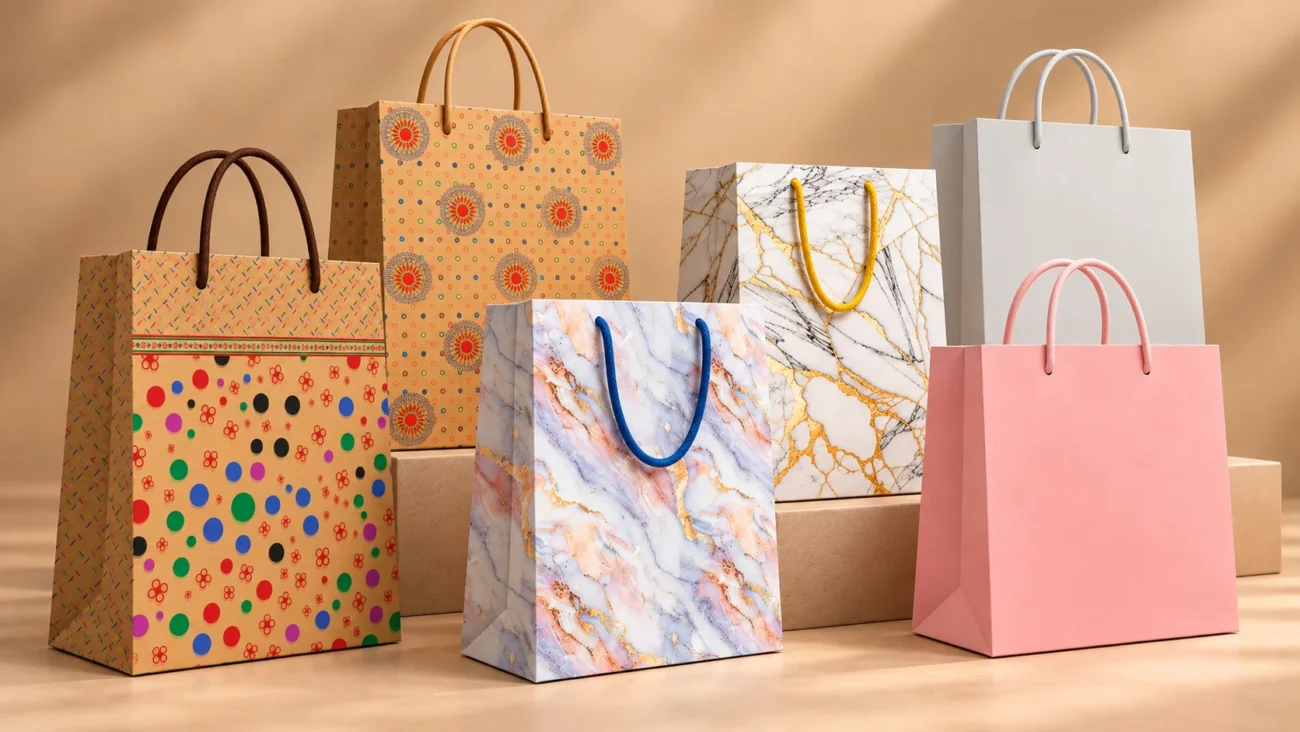
- Gift shops: Decorative paper bags can provide ready-made patterns and colors for gifting purchases.
- Boutiques and fashion retailers: Solid-color bags can help maintain a consistent appearance across different purchases.
- Bakeries and cafés: Kraft paper bags may suit suitable dry products and takeaway applications, provided the bag meets the product’s food-contact and handling requirements.
- Corporate gifting and events: Coordinated kraft or solid-color bags can help keep packaging consistent across multiple recipients.
- Festive and seasonal retail: Decorative designs provide visual variety for seasonal products and gift purchases.
The choice should also account for bag dimensions, handle strength, expected load, and the number of units required. A style that works for small purchases may not be suitable for heavier products or larger gift sets.
For businesses purchasing in quantity, it is useful to test samples before committing to a large order. This helps confirm that the bag is practical for the intended application and that the available sizes meet day-to-day requirements.
The Cost Question: Looking Beyond Price Per Unit
Cost is often the main hesitation when businesses consider switching to paper packaging. A paper bag can cost more per unit than a very thin plastic bag, so comparing only the purchase price may make plastic appear to be the more economical option.
However, businesses should consider several other factors before making a decision.
- Replacement and complaint costs: A bag that tears during normal use can require replacement and create an avoidable inconvenience for the customer.
- Reuse: A sturdy paper bag may be used several times, increasing the practical value of the original purchase.
- Presentation: For gift shops and boutiques, packaging contributes to how the purchase is presented and carried.
- Bulk pricing: Ordering larger quantities may reduce the per-unit cost, depending on the supplier, specifications, and order size.
- Supplier coordination: Sourcing multiple suitable packaging products from one supplier may simplify ordering and communication.
These factors do not mean paper is always cheaper overall. The actual cost depends on the product, bag specifications, order quantity, and frequency of use.
For businesses purchasing larger quantities, it is worth comparing cost per unit, expected performance, and suitability for the intended application rather than choosing exclusively on the lowest quoted price.
What to Check Before You Switch
Moving to paper packaging becomes easier when businesses evaluate their requirements before placing an order.
- Assess the typical load. Consider the weight and dimensions of the products customers usually purchase, including the heaviest common combination.
- Request a sample. Load the bag, carry it, and handle it as customers would during normal use.
- Check the material and finish. Understand the paper type, construction, coatings, and any implications for disposal or recycling.
- Inspect the handles and base. These areas should be suitable for the intended load and normal handling.
- Confirm lead times and MOQ. Check minimum order quantities, pricing, and delivery schedules before committing to a large order.
- Choose suitable sizes. A single bag size may not accommodate every product your business sells.
- Review the complete cost. Compare the specifications and expected performance of different options, not just their initial price.
Testing a sample before purchasing in bulk helps businesses identify unsuitable sizes or construction issues early.
Common Mistakes Businesses Make When Switching
Several avoidable mistakes can make a packaging change more difficult than necessary.
- Switching everything at once: Begin with the applications where paper packaging is most suitable, such as retail carry bags, before expanding to other formats.
- Choosing on price alone: A low-cost bag may not provide the strength or construction required for everyday use.
- Overstating sustainability claims: Describe the material and its properties accurately rather than assuming all paper packaging is equally recyclable or environmentally beneficial.
- Ignoring moisture requirements: Consider wet products, humidity, and delivery conditions before choosing an uncoated paper format.
- Ordering only one size: Different products often require different dimensions and load capacities.
- Skipping sample checks: Reviewing a sample can reveal problems with handles, dimensions, construction, or finish before a large order is placed.
The best approach is to start with the business’s actual packaging needs, evaluate suitable options, and expand only when the chosen format performs reliably.
The Bottom Line
The strongest case for paper packaging is not based on one benefit alone. It combines practical advantages: paper can support product presentation, offer printing flexibility, and suit many everyday retail and gifting applications. However, the businesses that make the most effective decisions are not necessarily those that switch the fastest. They are the ones that test samples, match the packaging to the product, compare costs realistically, and use other materials when the application genuinely requires them.
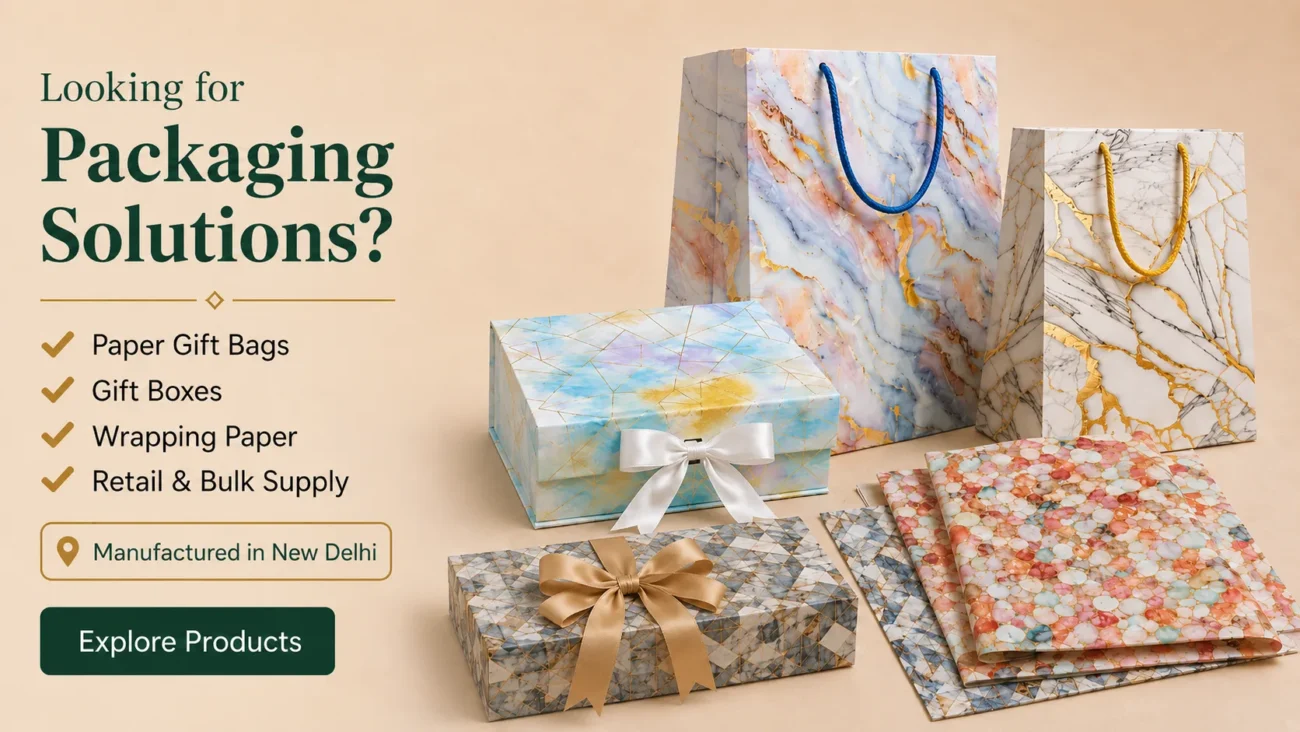
GiftNGreet, a paper packaging manufacturer based in New Delhi, supplies Kraft Paper Carry Bags, Decorative Paper Carry Bags, Solid Color Paper Carry Bags, Foldable Magnetic Lid Boxes, and Wrapping Paper as a ready-made range for retail, gifting, and business packaging requirements.
Explore GiftNGreet Packaging
Frequently Asked Questions
Paper packaging can offer advantages in product presentation, printing options, reuse, and suitability for many retail and gifting applications. Its environmental benefits depend on material composition, construction, and end-of-life handling.
Businesses may prefer paper because of its appearance, printing flexibility, customer-facing presentation, and suitability as an alternative to certain plastic carry bags. The best choice still depends on the product and its packaging requirements.
Not in every situation. Paper may offer advantages in renewable raw materials and recycling in suitable circumstances, but manufacturing impacts, coatings, durability, reuse, and local waste-management facilities also matter.
Paper bags often cost more than very thin plastic bags, although prices vary by specification and order quantity. Businesses should compare unit cost, performance, suitability, and expected reuse before deciding.
It can be, provided the paper weight, bag dimensions, base construction, and handle attachment are appropriate for the load. Testing a representative sample is advisable before placing a large order.
Yes. India has restrictions on specified single-use plastic items and requirements concerning plastic carry bags. Businesses should check the current central and applicable state or local requirements before making packaging decisions.
Start with one or two suitable bag sizes for common purchases. Test samples using typical products, confirm the cost and supplier lead time, and expand the range once the packaging meets the business’s requirements.
Businesses can source paper bags from packaging manufacturers and suppliers that serve retail and commercial buyers. Before ordering, confirm available sizes, construction, minimum order quantities, pricing, and delivery schedules.
GiftNGreet is a paper packaging manufacturer based in New Delhi, supplying paper bags and other ready-made packaging options for business requirements.
There are a lot of benefits of paper packaging but it also comes with its own disadvantages. Paper packaging can be more vulnerable to moisture, may cost more per unit than some plastic formats, and can be harder to recycle when it contains certain coatings or mixed materials.
Related Reading
- Paper Gift Bags vs Plastic Bags: Which Is Better?
- Kraft Paper Bags: Uses, Benefits & Applications
- Eco-Friendly Paper Packaging: What Businesses Should Know
- Guide to Paper Gift Bags for Retail Businesses
Manufactured in New Delhi
Packaging Designed For Every Occasion
Explore GiftNGreet’s collection of gift boxes, paper gift bags, wrapping paper, and packaging solutions suitable for gifting, retail businesses, celebrations, and everyday presentation.
Looking for packaging solutions? Visit our Contact Us page for retail and bulk enquiries.