
Packaging Insights
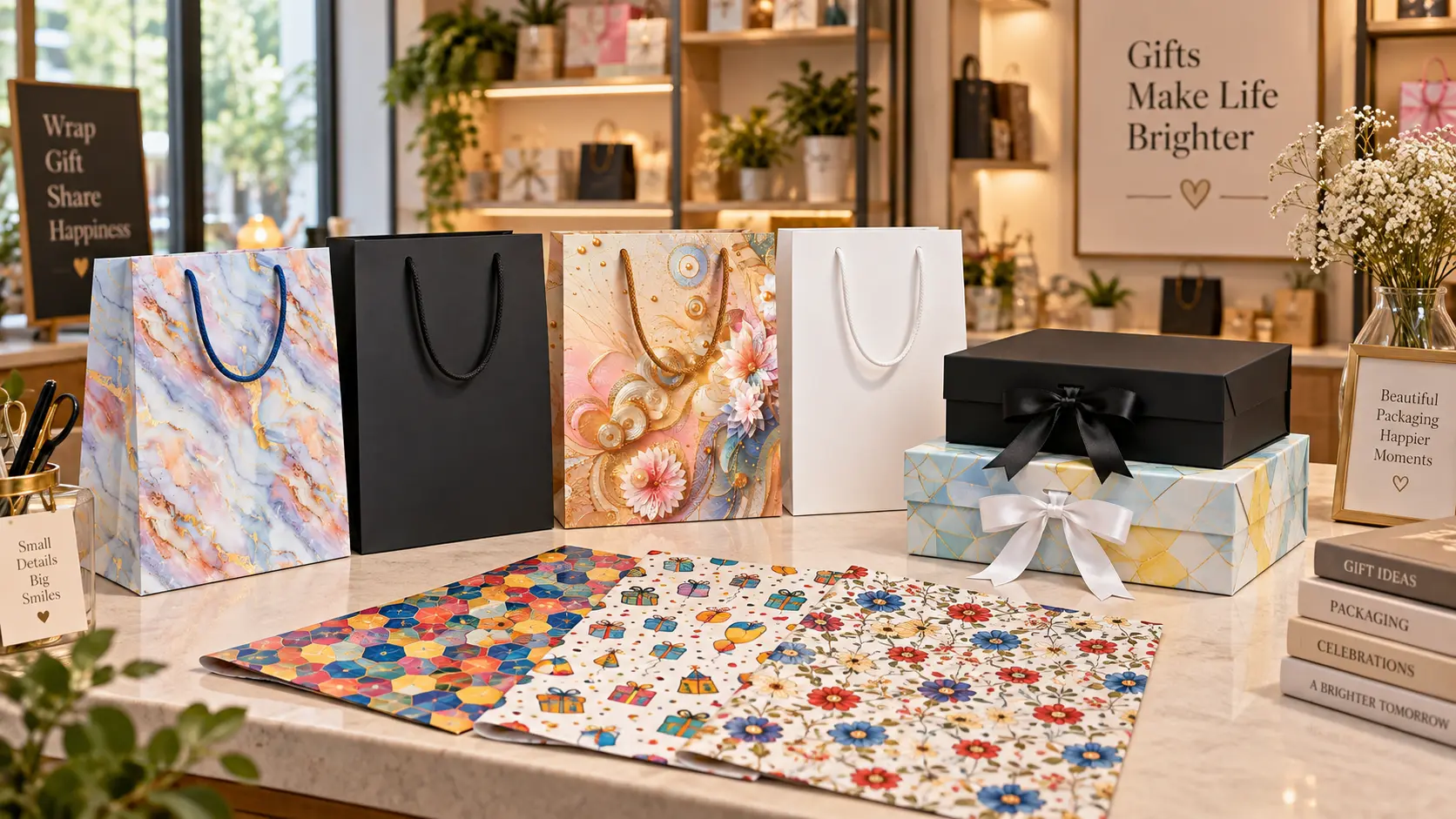
Run a gift shop for even a few months and you’ll notice something: customers remember how their purchase was presented almost as much as what they bought. Gift shop packaging isn’t a background detail in this kind of business — it’s part of the overall buying experience. A shop that gets it right can make a simple purchase feel well considered, while poor packaging can make even a good product feel like an afterthought.
This is a practical walk-through of what gift shop packaging actually involves, from the basic supplies every shop needs to how to choose and source them efficiently as the business grows.
The Short Version
Gift shop packaging works best when it is treated as a small, connected system rather than a collection of individual supplies.
- Paper gift bags and gift boxes are the two workhorses most shops build their packaging around.
- Wrapping paper, tissue paper, ribbons, and tags fill the gap between simply carrying a purchase and presenting it as a gift.
- Different sizes and styles help a shop handle everything from small purchases to larger gift items without using unsuitable packaging.
- A ready-made design range can cover a wide variety of presentation needs without requiring a separate packaging solution for every product.
- Paper-based packaging can be a practical choice for shops looking to reduce their reliance on plastic, although recyclability and end-of-life options depend on the specific packaging construction and local facilities.
- Buying in bulk from a reliable supplier can simplify ordering, improve stock availability, and make packaging easier to manage as the shop grows.
The goal isn’t to stock every possible packaging product. It is to build a practical packaging mix that covers the majority of your customers’ needs without creating unnecessary inventory or storage problems.
Why Packaging Deserves Real Attention in a Gift Shop
In most retail categories, packaging is primarily functional — it gets the product home safely and that’s the end of the story. A gift shop is different. The packaging often becomes part of the gift itself, particularly when a customer is buying something to give to someone else.
That changes the calculation entirely: gift shop packaging isn’t just about protecting a product; it also helps complete the presentation and experience the customer came to the shop for.
This is also why packaging decisions in a gift shop tend to compound over time. A shop with a messy mix of leftover bags and boxes from different periods can look disorganized even when the products themselves are well presented. A shop with a considered and consistent packaging setup creates a more organized impression, often before a customer has even picked anything up.
Packaging also affects the practical side of the business. The wrong bag size can mean wasted material, an unsuitable box can create storage problems, and running out of commonly used packaging during a busy period can slow down the checkout process.
For that reason, gift shops should think about packaging in terms of presentation, suitability, availability, and day-to-day practicality rather than appearance alone.
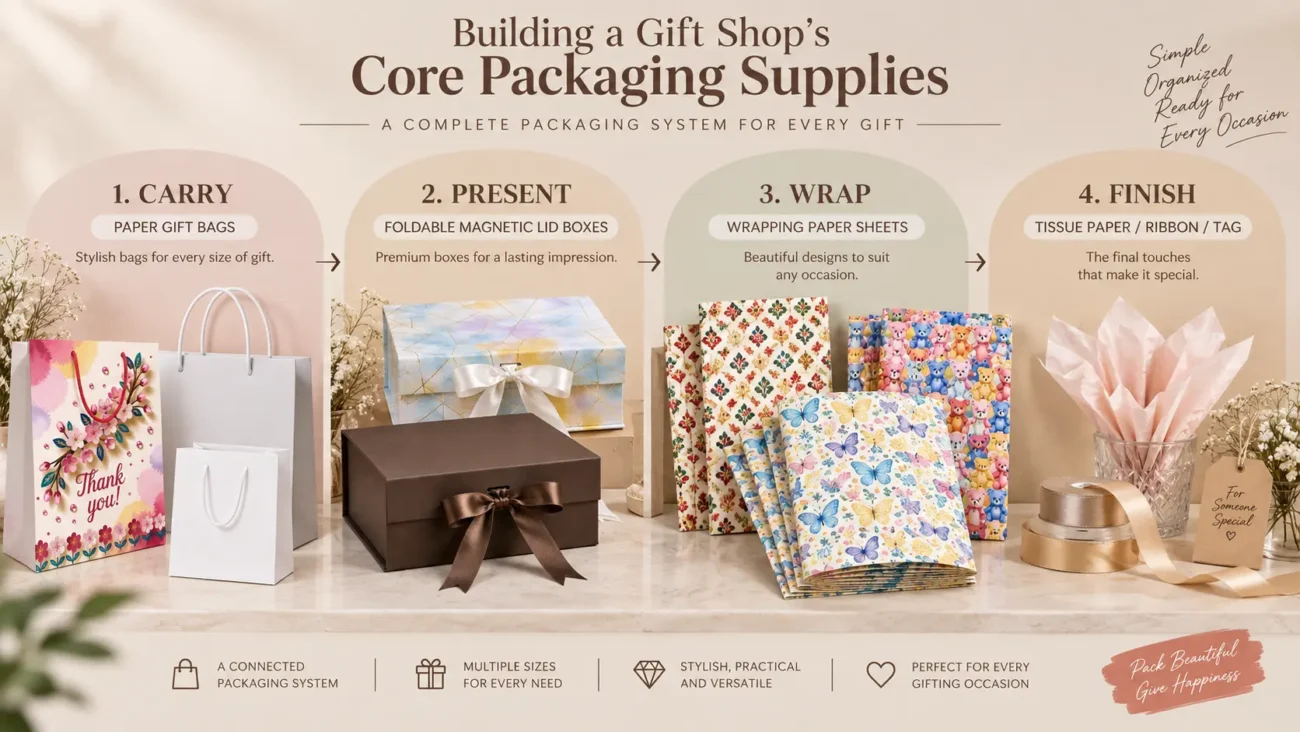
Building a Gift Shop’s Core Packaging Supplies
Before getting into specific products, it helps to think of gift shop packaging as a small system rather than a shopping list.
Most gift shops end up needing some combination of:
- A primary carrying option — paper bags or boxes for most purchases
- Gift boxes — for products that benefit from additional structure or presentation
- Wrapping paper — for irregularly shaped items or customers who prefer traditional gift wrapping
- Tissue paper — for lining bags and boxes or adding a layer around delicate products
- Finishing details — such as ribbons and tags
- Multiple sizes — enough variety to accommodate the shop’s main product range
The key is to build this range around actual sales patterns. A shop selling mostly small accessories may need more small bags and fewer large boxes, while a shop selling larger home décor or gift items may require a different mix.
Starting with the packaging formats that handle the majority of purchases makes inventory easier to manage and reduces the risk of buying large quantities of products that rarely get used.
Understanding different types of paper gift bags and their uses can also help when deciding which bag styles and sizes make sense for a particular gift shop.
Paper Gift Bags: The Everyday Workhorse
For most gift shops, paper gift bags end up doing more work than any other single packaging item, simply because they’re fast, flexible, and suitable for a wide range of purchases.
Different paper bag styles can serve different purposes:
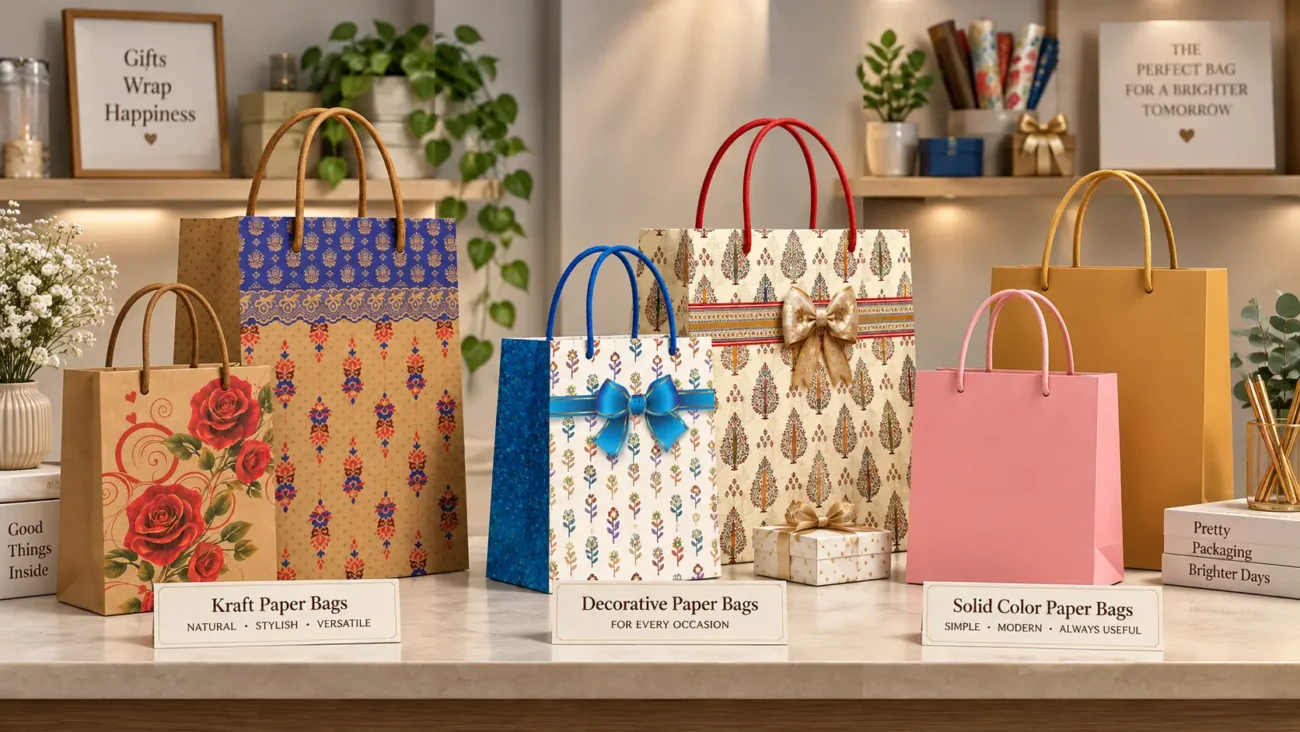
- Kraft paper bags work well for everyday purchases where a straightforward and sturdy format suits the product.
- Decorative paper bags add built-in visual interest for gifting purchases without requiring additional outer wrapping.
- Solid color paper bags provide a versatile option that can be paired with tissue paper, ribbon, or a tag.
- Rope handles provide a practical carrying option and can work across different bag styles when properly attached.
The most useful approach is usually to stock a sensible selection of sizes rather than a large number of nearly identical options. This allows staff to select a bag based on the product being purchased rather than simply choosing whichever size happens to be available.
For shops that handle a mix of everyday retail purchases and gift purchases, having a combination of kraft, decorative, and solid-color options can provide useful flexibility without making the packaging inventory unnecessarily complicated.
Gift Boxes: For When a Bag Isn’t Quite Enough
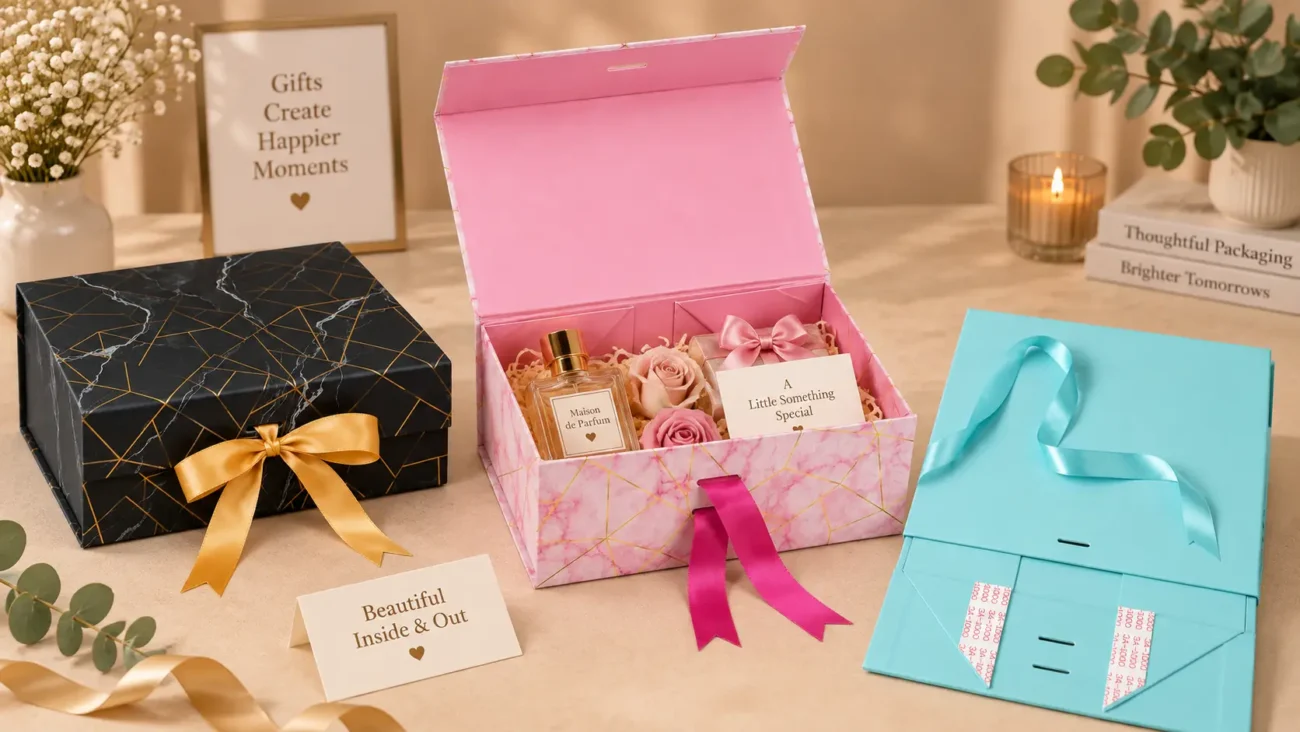
Paper gift bags work well for many everyday purchases, but some products are better suited to a box. Gift boxes provide a more structured way to present items and can be particularly useful when the product needs to stay contained, protected, or neatly arranged.
For gift shops, the goal isn’t to stock every possible box size. A smaller selection of useful sizes and formats is usually easier to manage. The right range should reflect the types of products customers actually buy rather than creating unnecessary inventory.
Foldable Magnetic Lid Boxes are one practical option for gift shops because they combine a structured box format with foldable construction. They can be used for smaller gifts and products where a more contained presentation works better than a carry bag. Ready-made options in marble-patterned and plain solid-color designs also give shops some visual variety without requiring a large number of different box formats.
The important consideration is matching the box to the product. A box that is too large wastes space and may require additional filling, while one that is too small can make packing difficult. Before buying in quantity, check the internal dimensions and consider the products the box will actually be used for.
Wrapping Paper: The Flexible Middle Ground
Wrapping paper fills a useful gap between a simple carry bag and a fully boxed presentation. It can be used for products of irregular shapes, items that do not need a rigid container, or gifts that customers want wrapped separately.
For a gift shop, keeping a manageable selection of wrapping paper patterns can make the checkout process more flexible. Instead of carrying a large number of designs, shops can choose patterns that work across several occasions and product categories.
Wrapping paper can also work alongside other packaging supplies. A gift can be wrapped first and placed inside a paper bag, or wrapping paper can be used inside a gift box to create a more organized arrangement.
For ideas on using wrapping paper in different situations, see our guide to creative ways to use wrapping paper beyond traditional gift wrapping.
Tissue Paper: The Detail Customers Notice Without Realizing It
Tissue paper is a relatively simple packaging supply, but it can make a noticeable difference to how products are arranged inside a bag or box.
It can be used to:
- Line the inside of a gift bag
- Fill unused space around a product
- Separate items inside a box
- Add a layer between products
- Provide a simple finishing detail
Gift shops generally do not need dozens of tissue paper colors. A few versatile shades that work with the shop’s existing bags, boxes, and wrapping paper can cover most everyday requirements.
Tissue paper is also useful from a practical perspective. When a box or bag is slightly larger than the product, carefully placed tissue can help keep the contents from moving around excessively during handling.
Ribbons and Tags: Small Additions That Finish the Look
Ribbons and tags are not essential for every purchase, but they can be useful when a gift needs an additional finishing detail.
The easiest approach is to keep these elements coordinated with the main packaging rather than treating them as separate design decisions. For example, a small number of ribbon colors can work across several bag and wrapping-paper designs.
Tags can serve different practical purposes depending on the shop. They may be used for:
- Short gift messages
- Product or price information
- Occasion-specific notes
- Basic business identification
The key is consistency. A few well-chosen options are generally more useful than a large collection that makes the packaging system difficult to manage.
Decorative Packaging: Where Gift Shops Can Stand Out
Decorative packaging gives gift shops an opportunity to introduce more visual variety without changing their entire packaging system.
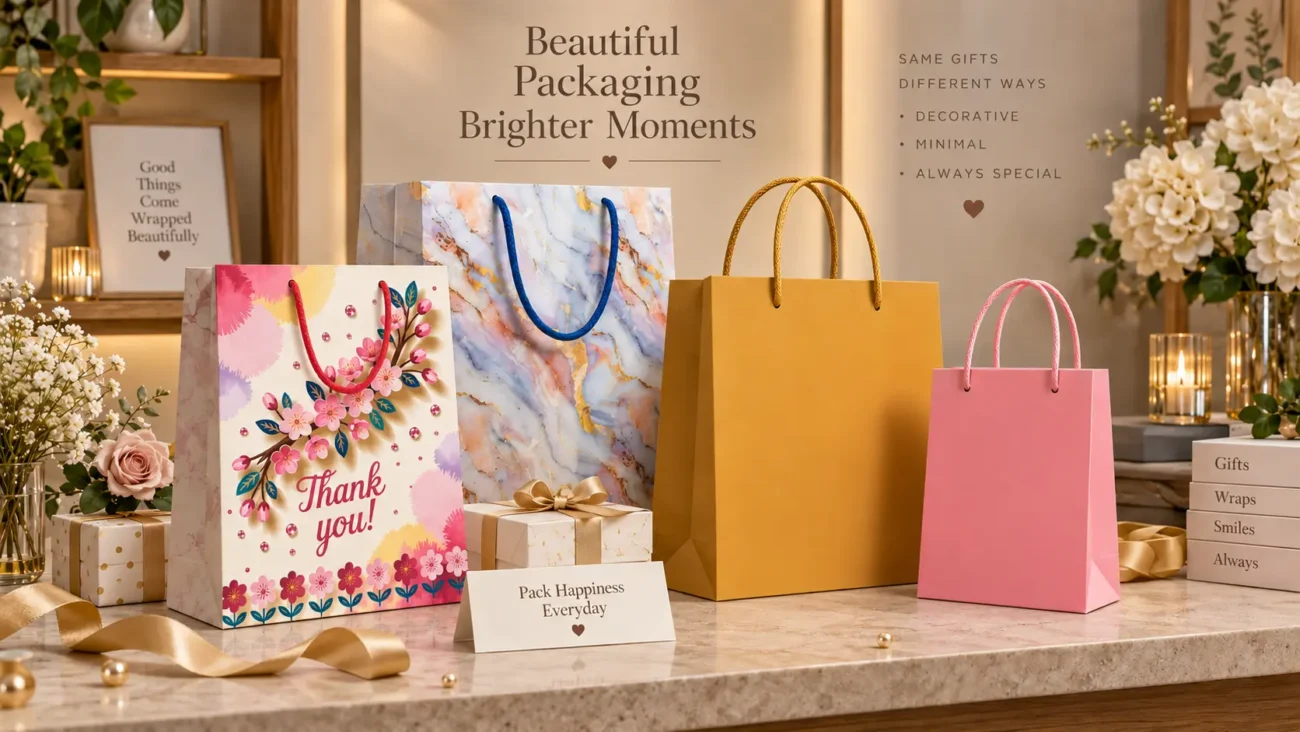
Printed paper bags, patterned packaging, and seasonal designs can be introduced alongside everyday options such as kraft and solid-color bags. This allows a shop to adjust its packaging selection around festivals, celebrations, and other periods of higher gifting demand.
The important point is to manage variety carefully. Too many unrelated designs can make the packaging area look disorganized and can leave the shop with excess stock when a particular season ends.
A practical approach is to maintain a core range of everyday packaging and add a smaller selection of occasion-specific designs when demand justifies it. Our guide to decorative paper bags for festive and seasonal gift shop packaging covers how these bags can be selected and used across different celebrations.
Ready-Made Design Variety vs. Special Orders
Gift shops need variety, but they also need a packaging system that is easy to maintain. This is where a ready-made packaging range can be practical. Instead of sourcing a completely different packaging option whenever a new occasion or product comes up, a shop can build its regular stock around a selection of established sizes, formats, colors, and patterns.
A ready-made range can cover many common requirements:
- Everyday retail purchases
- Festivals and seasonal gifting
- Different product sizes
- Different presentation styles
- Gift bags and boxes
- Additional wrapping requirements
The advantage is not simply having more designs. It is being able to reorder packaging that already fits the shop’s requirements and maintain greater consistency across purchases.
For a growing gift shop, this can also make stock planning easier. Once the business knows which bag sizes, box formats, and designs are used most frequently, those items can become part of the regular purchasing cycle.
Sustainability: A Growing Expectation, Not Just a Trend
Packaging choices are increasingly considered alongside material use, disposal, and the overall amount of packaging required for a purchase.
Paper-based packaging can be a practical option for many gift shops, but sustainability should not be judged by material name alone. Paper packaging is not automatically sustainable in every situation. Its environmental impact can depend on how much material is used, how the product is constructed, whether it can be reused, and what recycling or waste-management facilities are available locally.
Gift shops can make more practical decisions by considering:
- Whether the packaging is appropriately sized
- How much material is being used
- Whether the bag or box can be reused
- Whether different materials are unnecessarily combined
- How the packaging is likely to be disposed of
- Whether the local waste system can process the material
For businesses exploring these considerations in greater detail, our guide to [eco-friendly paper packaging and what businesses should know] explains the factors that matter when evaluating paper-based packaging.
The objective should be to choose packaging that is suitable for the product and practical throughout its use and disposal, rather than relying only on a sustainability label.
Wholesale and Bulk Purchasing: Making the System Sustainable to Run
Once a gift shop has identified its regular packaging requirements, buying in larger quantities can make the purchasing process easier to manage.
Bulk purchasing can help reduce the frequency of orders and may lower the effective cost per unit. However, buying more is not automatically better. Packaging should be purchased according to realistic sales patterns, available storage space, and expected seasonal demand.
Before placing a larger order, consider:
- Regular consumption — Which bags, boxes, and other supplies move most frequently?
- Seasonal demand — Will festivals or gifting periods significantly increase usage?
- Storage space — Can the packaging be stored without damaging it?
- Product range — Are the selected sizes suitable for the products actually sold?
- Reordering — Can the same packaging be sourced again when stock runs low?
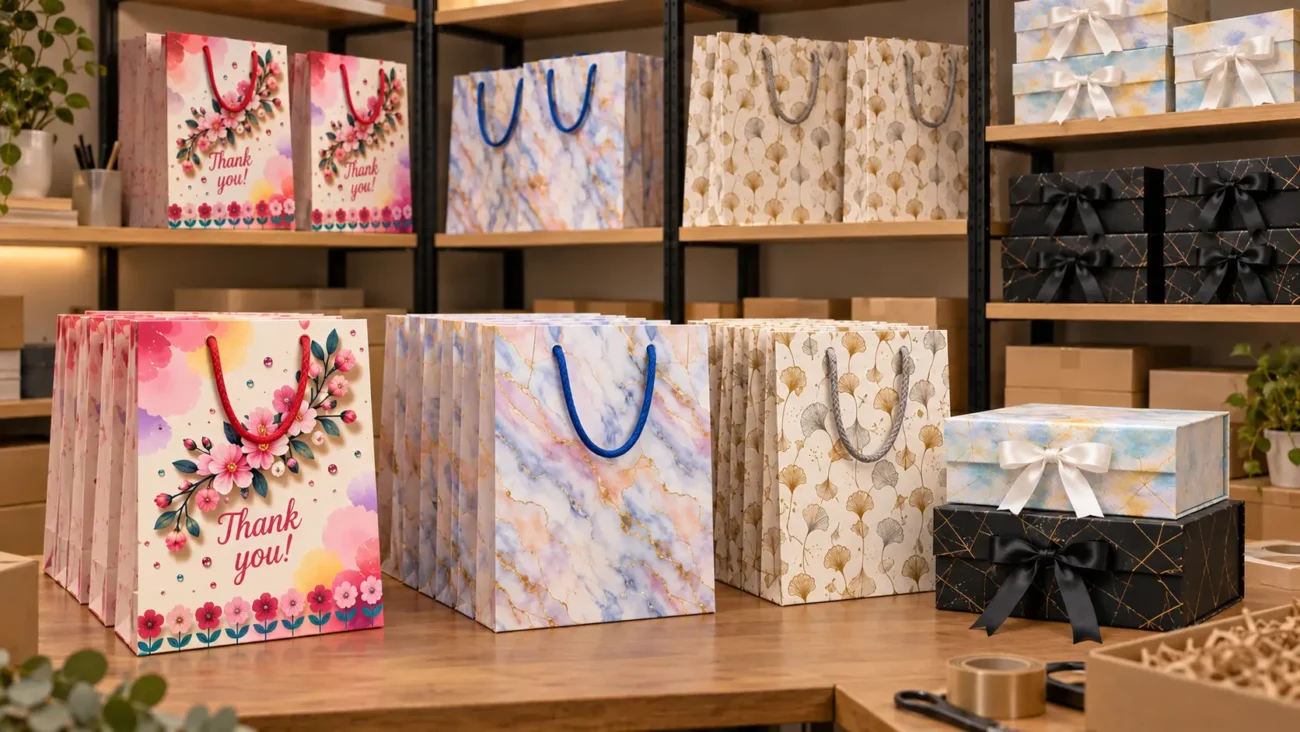
Foldable packaging can be particularly useful where storage space is limited because it can occupy less space before use.
A simple stock system is usually more useful than buying large quantities of every available design. Keep core packaging consistently available and increase seasonal stock when there is a clear reason to do so.
Choosing a Packaging Manufacturer or Supplier in India
The supplier you choose can affect much more than the initial purchase price. For a gift shop, reliability, product consistency, available formats, and communication can become increasingly important as packaging purchases become regular.
When comparing a packaging manufacturer or supplier in India, consider:
- Product Range: A supplier offering several relevant packaging formats can simplify purchasing. For a gift shop, this may include paper bags, gift boxes, and wrapping materials.
- Ready-Made Availability: Check whether the supplier has a suitable ready-made range that matches your regular packaging requirements. This can make repeat purchasing more straightforward.
- Product Consistency: Ask how the supplier maintains consistency in dimensions, construction, printing, and finishing across larger quantities.
- Lead Times: Understand how long regular orders generally take and whether seasonal periods can affect availability.
- Samples and Product Evaluation: Before committing to a large quantity, evaluate the actual packaging. Check dimensions, paper quality, handles, construction, finish, and suitability for the products you sell.
- Communication and Reordering: A supplier should be able to clearly communicate available products, quantities, order requirements, and expected timelines. This becomes especially important when the same packaging needs to be reordered regularly.
For gift shops, the practical question is not simply “Who sells packaging?” but “Who can supply the packaging range my shop actually uses, consistently and predictably?”
Bringing the System Together
A gift shop does not need to build its entire packaging system at once.
Start with the products that account for most customer purchases. Add a few useful bag sizes, suitable gift boxes, and a manageable selection of wrapping paper and finishing materials. Once actual sales patterns become clear, the packaging range can be adjusted accordingly.
This approach helps avoid two common problems: running out of frequently used packaging and accumulating large quantities of packaging that rarely gets used.
For example, a shop may build its core range around Kraft Paper Carry Bags, Decorative Paper Carry Bags, Solid Color Paper Carry Bags, Foldable Magnetic Lid Boxes, and Wrapping Paper, then add tissue paper, ribbons, or tags according to its day-to-day requirements.
The result is a packaging system that is easier to stock, easier to reorder, and better aligned with the products and occasions the shop actually handles.
Gift-N-Greet, a paper packaging manufacturer based in New Delhi, offers ready-made packaging options for businesses looking to source paper bags, gift boxes, and wrapping materials. Its range includes Kraft Paper Carry Bags, Decorative Paper Carry Bags, Solid Color Paper Carry Bags, Foldable Magnetic Lid Boxes, and Wrapping Paper.
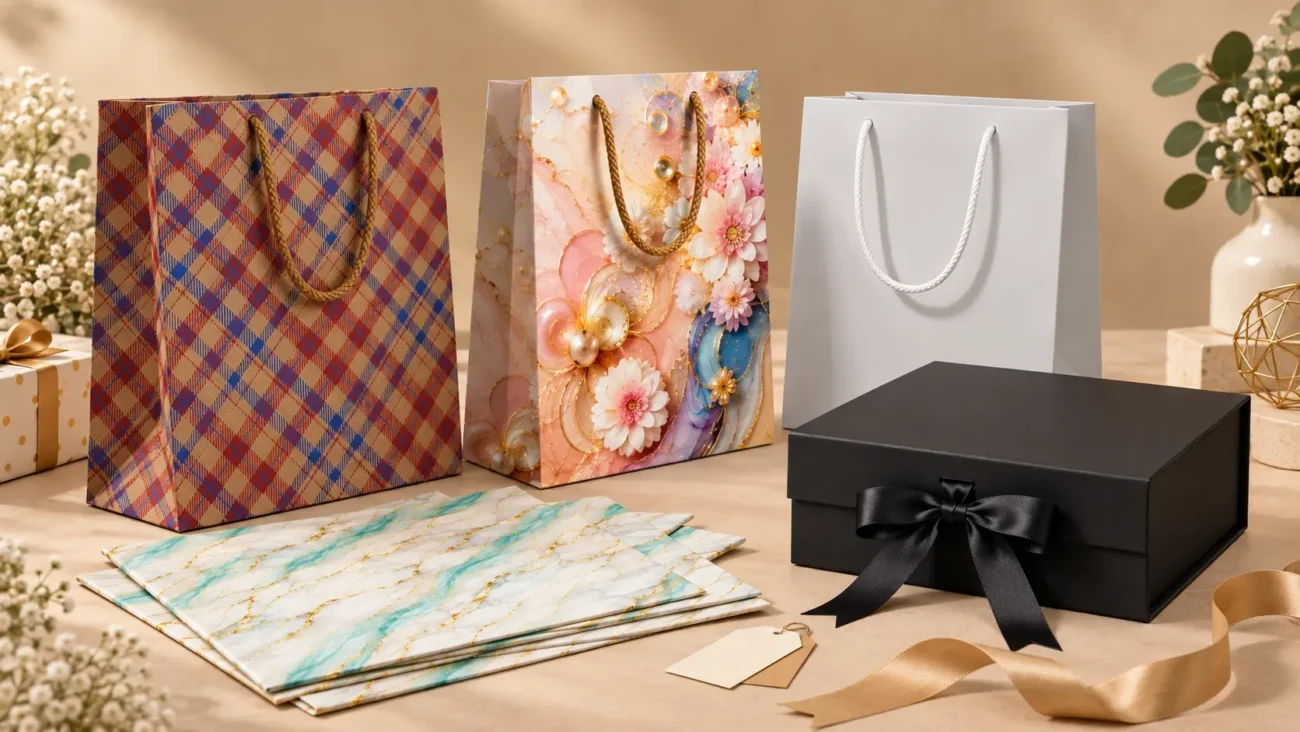
For businesses looking for ready-made gift packaging, selecting a suitable box or bag based on product size, presentation requirements, and intended use can help create a more consistent customer experience.
Explore:
Wrapping Paper Sheets for Gift Packaging
Ready-made Magnetic Lid Gift Boxes
Ready-made Paper Gift Bags for Retail and Gifting
To enquire about available products and bulk purchasing requirements, contact GiftNGreet.
Frequently Asked Questions
A practical gift shop packaging range usually includes paper gift bags, gift boxes, wrapping paper, tissue paper, and optional finishing items such as ribbons and tags. The exact mix should depend on the products sold, customer requirements, and seasonal demand.
There is no fixed ratio. Paper bags are often useful for everyday purchases, while boxes are better suited to products that benefit from a structured presentation. Review actual sales patterns and stock accordingly rather than applying the same mix to every shop.
Yes. Wrapping paper can handle products that do not fit conveniently into bags and gives customers another presentation option. It can also be used inside boxes or alongside bags.
It can. Customers may consider the materials used and how packaging can be reused or disposed of. However, sustainability should be assessed based on factors such as material usage, construction, reuse, and local recycling or waste-management facilities rather than simply choosing packaging labelled as sustainable.
Using one supplier can simplify ordering, communication, and repeat purchases when that supplier offers the packaging formats and specifications the shop actually needs. Using multiple suppliers may make sense when different suppliers are better suited to specific requirements.
A ready-made range gives a shop access to established sizes, formats, colors, and patterns without having to source packaging separately for every requirement. It can also make repeat ordering and inventory planning easier.
Once the shop has enough sales history to identify its regularly used packaging, bulk purchasing becomes easier to plan. Seasonal demand, storage capacity, cash flow, and supplier lead times should also be considered before increasing order quantities.
Ask about product specifications, dimensions, material or GSM, available quantities, lead times, consistency between orders, storage requirements, and sample availability. It is also useful to confirm how the products are packed and supplied for larger quantities.
They can. Foldable boxes can occupy less space before use than fully assembled boxes, which can make them easier to store when available space is limited. The actual storage advantage depends on the box construction and how it is supplied.
Related Reading
- Guide to Paper Gift Bags for Retail Businesses
- How Retail Stores Benefit from Organized Gift Packaging
- Choosing Packaging for Bulk Orders
- Decorative Paper Bags for Festivals & Celebrations
Manufactured in New Delhi
Packaging Designed For Every Occasion
Explore GiftNGreet’s collection of gift boxes, paper gift bags, wrapping paper, and packaging solutions suitable for gifting, retail businesses, celebrations, and everyday presentation.
Looking for packaging solutions? Visit our Contact Us page for retail and bulk enquiries.