
Packaging Insights
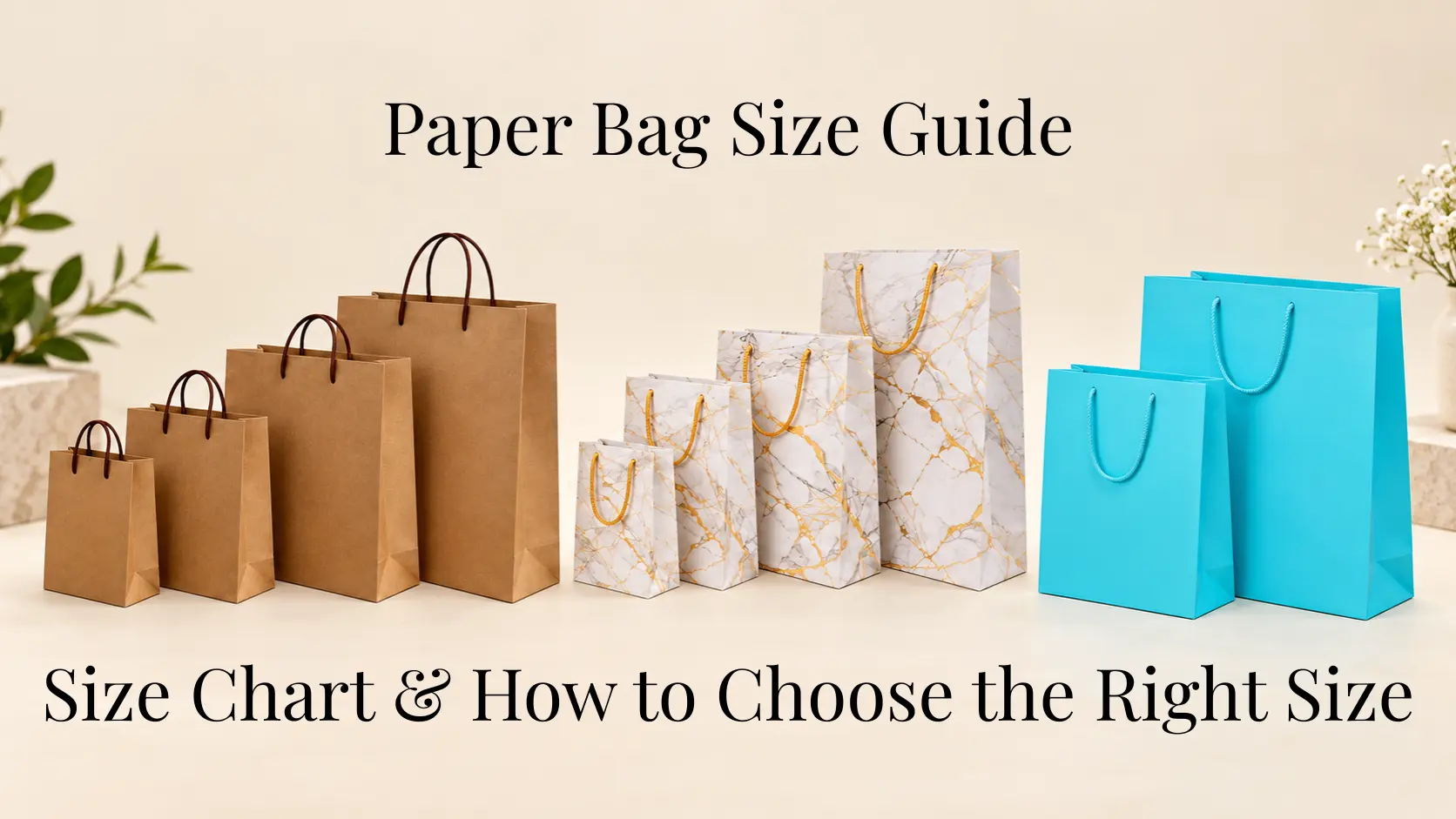
You’ve probably seen both versions of this mistake. The first is a bag that’s slightly too small: the handles are strained, the gift is forced in at an angle, and the paper begins to crease before it leaves the shop. The second is a bag that’s far too large, with a small box sliding around at the bottom and excessive empty space above it. Both problems have the same cause: choosing a paper bag size based on a label such as “small” or “medium” instead of checking its actual dimensions.
This paper bag size guide explains how bag dimensions are written, how to measure your product, how much clearance to allow, and which sizes generally suit different products. It’s designed for shop owners buying packaging in bulk as well as anyone choosing a bag for an individual gift.
The Short Version
- Paper bag dimensions are commonly listed as width × gusset × height, so check all three measurements.
- Measure your product’s width, depth, and height before selecting a bag.
- Allow roughly 2–3 cm of extra width, 1–2 cm of extra gusset, and 3–5 cm of extra height as a starting point.
- The gusset—the depth of the bag—is one of the most commonly overlooked measurements.
- Labels such as “small” and “medium” vary between manufacturers, so compare the actual dimensions.
- A larger bag does not automatically carry more weight. Paper strength, base construction, and handle attachment also matter.
How Paper Bag Sizes Are Written
Before comparing paper bag size and dimensions, it’s important to understand how manufacturers list them. Many suppliers provide three measurements, commonly in this order:
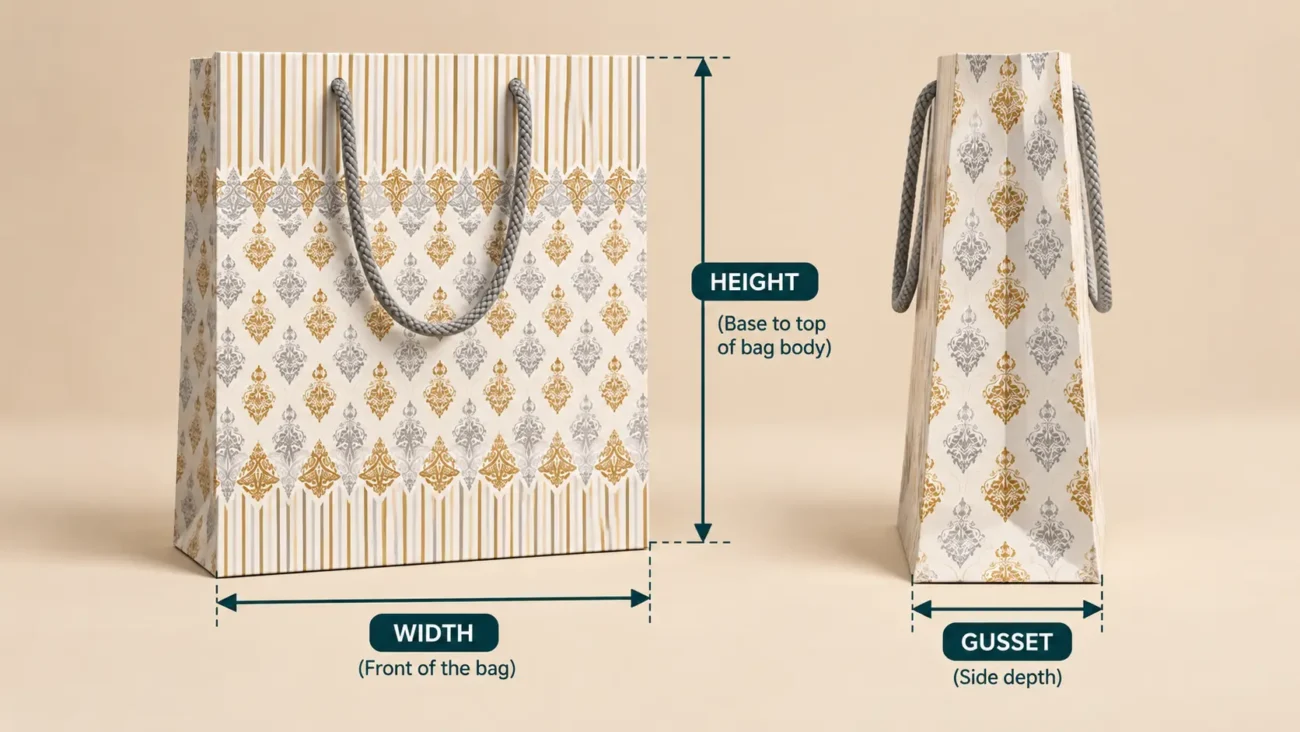
Width × Gusset × Height — sometimes written as W × G × H or W × D × H.
However, some manufacturers list dimensions in a different order. Always check the supplier’s notation before comparing sizes.
- Width: Width is the measurement across the front of the bag when it is opened out and viewed from the front. It determines how wide a product can be without pressing against the sides.
- Gusset: The gusset is the folded side or bottom section that gives the bag depth and helps it accommodate products with thickness. It determines how much room is available from front to back. A gusset that is too narrow may prevent a box from sitting properly. One that is too wide can leave a small product moving around inside the bag.
- Height: Height is usually measured from the base to the top edge of the bag body. At many suppliers, it excludes the handles, so confirm the supplier’s measurement method. The folded base can also affect the usable internal height. For this reason, a product that matches the listed height exactly may still be difficult to place inside the bag.
A Note on Units: Bag sizes may be listed in centimetres or inches. As a quick reference, 1 inch = 2.54 cm.
GiftNGreet’s supplied size information lists dimensions in inches using the order length × height × breadth. In the charts below, these are converted to width × gusset × height in centimetres to make the dimensions easier to compare.
How to Choose the Right Paper Bag Size: Step by Step
Whether you’re choosing one bag or ordering several hundred, the same basic process applies.
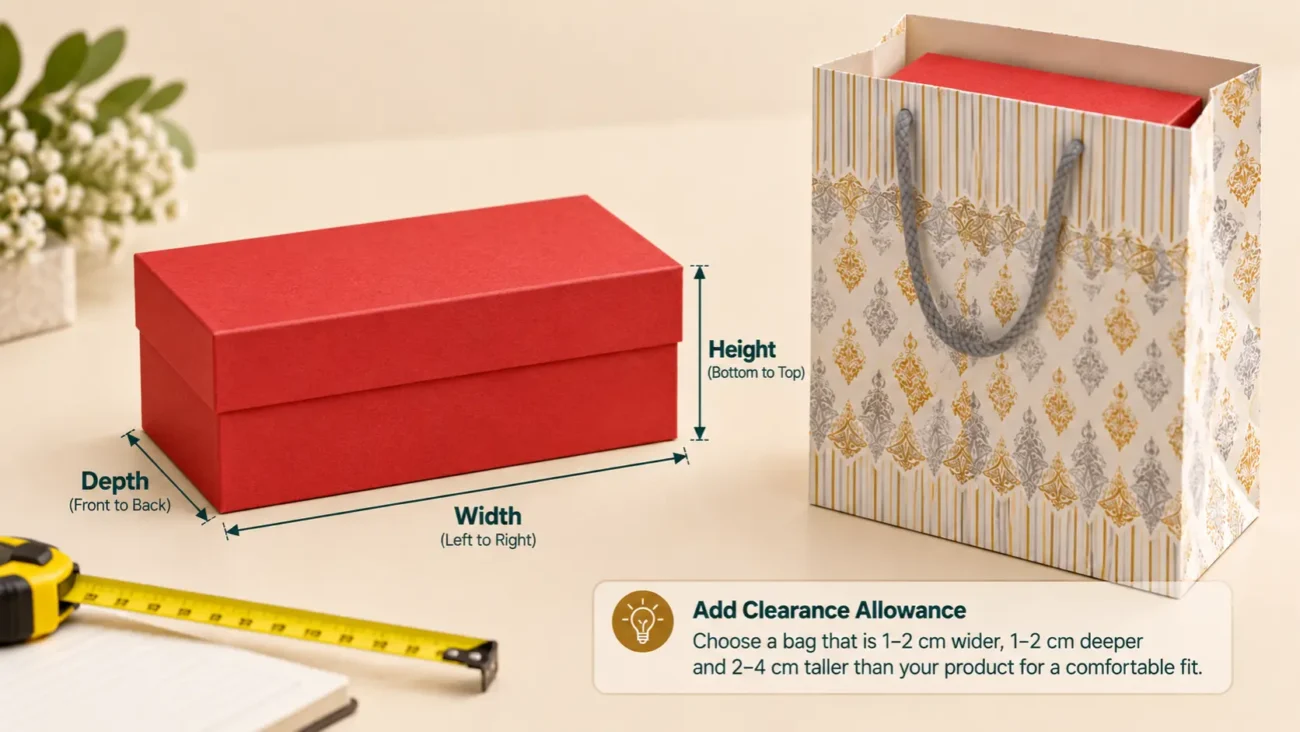
- Measure the product in three dimensions. Record its width, depth, and height at the widest or tallest points. Include protruding parts, lids, and handles where relevant.
- Match the gusset to the product’s depth. As a starting point, allow around 1–2 cm more than the product’s depth.
- Match the bag width to the product width. Allow roughly 2–3 cm of additional width so the product can be inserted without forcing it.
- Allow enough height. Add around 3–5 cm to the product’s height, with more room if you plan to use tissue paper or fold the top.
- Consider the weight. Heavier products need suitable paper strength, a secure base, and handles that can support the load.
- Test the fit. Place the actual product in the selected bag and lift it by the handles to check the fit and handling.
A Quick Sizing Rule of Thumb
| Dimension | Suggested allowance |
|---|---|
| Width | Product width + 2–3 cm |
| Gusset | Product depth + 1–2 cm |
| Height | Product height + 3–5 cm; allow more for tissue or a folded top |
These measurements are starting points, not a guarantee that every product will fit. Product shape, packaging, and the bag’s construction can affect the result. A close fit may look neat, but a bag that is too tight can strain its seams and make packing difficult.
Paper Bag Size Chart: GiftNGreet Sizes in Inches and Centimetres
The following charts use the dimensions supplied for GiftNGreet’s paper and kraft paper bags. The original measurements are shown alongside the converted dimensions. The largest product that fits column applies the clearance allowances described earlier: 3 cm for width, 1.5 cm for gusset, and 4 cm for height. These calculated figures are estimates, not physically tested product-fit claims. Test the actual product before placing a large order.
- Paper Bags:
| Size | Listed size (inches, L × H × B) | Width × Gusset × Height (cm) | Estimated product size (W × G × H, cm) | Suitable for |
|---|---|---|---|---|
| Jumbo | 15 × 20 × 6 | 38.1 × 15.2 × 50.8 | About 35 × 13 × 46 | Bulky items, large hampers, several boxed gifts |
| Large | 12.5 × 16.5 × 4.5 | 31.8 × 11.4 × 41.9 | About 28 × 9 × 37 | Folded apparel, larger boxed gifts, small hampers |
| Medium | 10.25 × 12.5 × 3.75 | 26.0 × 9.5 × 31.8 | About 23 × 8 × 27 | Books, folded shirts, medium gift boxes |
| Small | 7 × 9 × 3.25 | 17.8 × 8.3 × 22.9 | About 14 × 6 × 18 | Boxed cosmetics, small candles, compact gifts |
| Nano | 6 × 7.25 × 3.5 | 15.2 × 8.9 × 18.4 | About 12 × 7 × 14 | Jewellery boxes, small accessories, samples |
- Kraft Paper Bags:
| Size | Listed size (inches, L × H × B) | Width × Gusset × Height (cm) | Estimated product size (W × G × H, cm) | Suitable for |
|---|---|---|---|---|
| Large | 16.5 × 12.5 × 4.5 | 41.9 × 11.4 × 31.8 | About 38 × 9 × 27 | Wide, flat items such as folded apparel or flat boxes |
| Medium | 10 × 14 × 4 | 25.4 × 10.2 × 35.6 | About 22 × 8 × 31 | Tall, slim items such as books, stationery sets, tall boxes |
| Small | 7 × 10 × 3.5 | 17.8 × 8.9 × 25.4 | About 14 × 7 × 21 | Small boxed gifts, cosmetics, accessories |
| Nano | 6 × 7.25 × 3.5 | 15.2 × 8.9 × 18.4 | About 12 × 7 × 14 | Jewellery boxes, small accessories, samples |

What the Charts Show –
- Nano is the same size in both ranges, making it easier to standardise this size if you stock both types.
- Kraft Medium is taller and narrower in front width than Paper Medium, which may suit taller, slimmer products.
- Kraft Large is wider than it is tall according to the supplied dimensions, making it more suitable for wide, relatively flat items.
- Jumbo is listed only in the paper bag range in the supplied size information.
Always compare your product’s measurements with the actual dimensions rather than relying on the size name alone.
Important verification before publication: The Kraft Large dimensions differ noticeably in proportion from Paper Large. The table preserves the supplied figures, but confirm that the original Kraft Large measurements were not entered in the wrong order. Also confirm whether the first chart covers both decorative and solid-colour paper bags.
Matching Paper Bag Sizes to Different Products
A size chart is a useful starting point, but real products differ in shape, weight, and packaging. When choosing a paper bag, consider not only whether the product fits but also how securely it sits inside the bag.
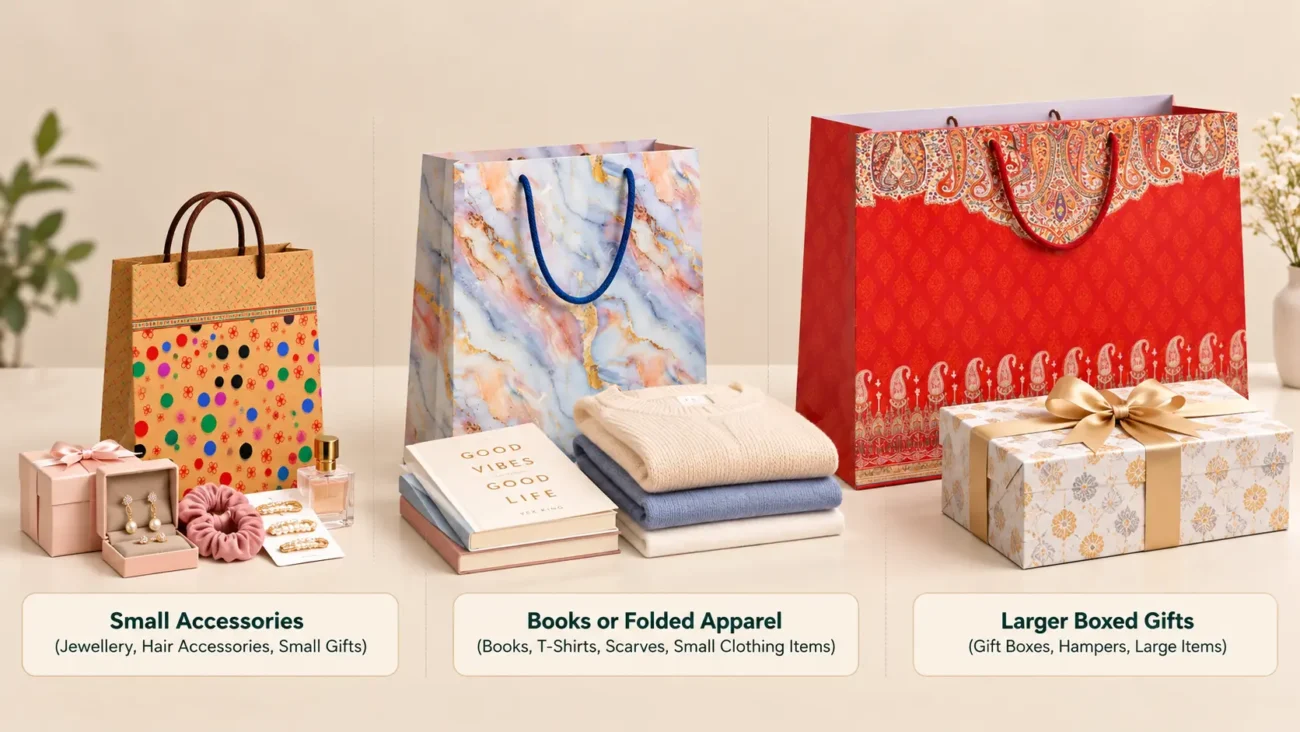
- Jewellery and Small Accessories: Jewellery and small accessories are often already packed in boxes. A Nano or Small bag may be suitable, depending on the box dimensions. Choose a bag with enough width and gusset to accommodate the box without forcing it inside. If the bag is much wider than the product, tissue paper can help reduce movement and keep the gift upright.
- Cosmetics and Perfume: Cosmetic bottles and jars can be relatively heavy for their size and are often tall or narrow. Check the height and gusset carefully, especially when packing several items together. If the products are in glass containers, consider how they will be protected from movement and contact with one another. Tissue paper may improve presentation, but suitable protective packaging should be used where needed.
- Clothing and Textiles: Folded clothing is flexible, so the bag needs enough width for the folded garment and sufficient height to accommodate the product and any tissue paper. Medium or Large bags may work for some folded garments, but the best choice depends on the actual folded dimensions. Measure the garment after folding it in the way it will be packed.
- Books and Stationery: Books can be heavy relative to their size, and their hard corners may press against the bag. Choose a width that accommodates the book, a gusset that matches its thickness, and a bag with suitable base and handle construction. For stationery sets, measure the complete packaged set rather than each item separately. This helps ensure the outer bag fits the product as it will actually be sold or gifted.
- Boxed Gifts: Boxed gifts require particular attention to the gusset because the box has a fixed depth. A bag may have sufficient width and height but still be too narrow from front to back. Measure the box in all three dimensions and compare them with the bag’s usable dimensions. If you need help measuring the gift box itself, see our guide to choosing the right gift box size for different products.
- Wine and Bottles: Bottles are tall and narrow, so a standard paper bag may not provide the best fit. A dedicated bottle bag can be more practical when its dimensions and construction are suitable for the bottle. Check the bottle’s height, diameter, and weight before choosing the bag. Our guide to wine bottle gift bags and when to use them covers the main considerations.
- Sweets, Cakes, and Food Gifts: When packing food gifts, measure the outer food container rather than just the food itself. A cake box, sweet box, or dry-fruit container determines the space the bag must accommodate. Allow enough room for the container to be inserted and removed easily. Keep oily or moist foods in suitable inner packaging, since ordinary paper bags should not be treated as oil-proof or moisture-proof.
- Hampers and Multi-Item Gifts: For a hamper, consider the combined footprint of all the items, including their individual packaging. Arrange the items as they will sit inside the bag or box, then measure the overall width, depth, and height. Allow extra height for tissue paper or other suitable protective material. A wider gusset may help accommodate a broad arrangement, but the package should still be stable and easy to carry.
Size Isn’t Strength: Weight, Paper, and Handles
A bigger bag doesn’t automatically carry more weight. The bag’s carrying capacity depends on its paper, base construction, and handle attachment—not just its dimensions.
Three factors are especially important when choosing a bag for heavier products.
- Paper weight (GSM): GSM refers to grams per square metre. Paper weight is one factor that affects stiffness and handling strength, although the paper grade and overall bag construction also matter.
- The base: A well-constructed base helps distribute the load and reduces the risk of the bottom sagging during use.
- The handles: Handle material and attachment both matter. Handles secured through suitable reinforced points may distribute the load more effectively than handles attached to a small, unsupported area.
When choosing a bag for a heavy product—such as a bottle, hardcover book, or boxed gift—check the construction as well as the dimensions. A bag may fit the product perfectly and still be unsuitable for its weight.
The Gusset: The Measurement Most People Forget
If you remember one thing from this guide, make it this: check the gusset.
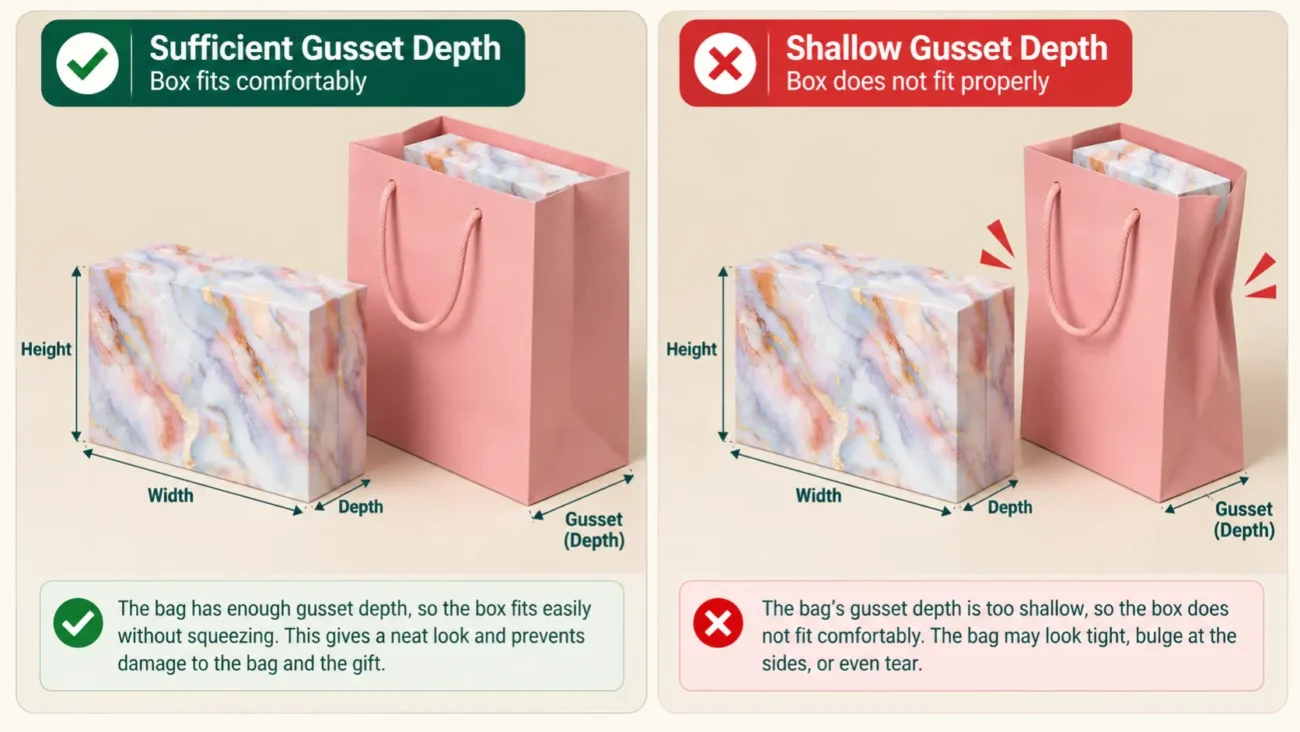
The gusset determines how much depth the bag can accommodate. It is particularly important for rigid items such as books, gift boxes, product cartons, and containers.
- A bag can be wide and tall enough but still be too shallow for the product.
- A narrow gusset can force the product to sit at an angle or press the sides of the bag outward.
- An excessively wide gusset can leave a small box moving around inside the bag.
- A suitable gusset helps the product sit more naturally and makes packing easier.
When a supplier lists only width and height, ask for the gusset measurement before placing an order. This is particularly important when purchasing packaging in bulk, because a sizing issue can affect an entire batch.
Common Paper Bag Size Mistakes
Choosing the right bag becomes easier when you know which mistakes to avoid.
- Going by the size label alone: “Small,” “Medium,” and “Large” can mean different dimensions across suppliers. Compare the actual measurements.
- Ignoring the gusset: A bag may have sufficient width and height but still be too shallow for the product.
- Choosing an exact fit: A product with almost no clearance can be difficult to insert and may put pressure on the seams.
- Assuming a larger bag can carry heavier items: Size does not guarantee carrying capacity. Check the paper, base, and handle construction.
- Forgetting inner packaging: A gift box, tissue paper, or protective layer adds to the overall dimensions. Measure the complete item as it will be packed.
- Skipping a fit test: Before placing a large order, test the actual product in the proposed bag and check how it sits when lifted.
These checks are especially useful for businesses buying packaging in quantity, where a small sizing error can affect hundreds of bags.
Choosing Paper Bag Sizes for a Shop or Business
Businesses rarely need a different paper bag size for every product. A more practical approach is to choose a small set of sizes that covers the majority of products sold.
Follow these steps to build a useful size range:
- List your products. Measure the smallest and largest items in each product category, including their existing boxes or packaging.
- Group products by size. Create three or four broad groups based on their width, depth, and height.
- Choose a bag for each group. Use the measurements in this guide to identify suitable options, and test products that sit near the upper limits.
- Check the weight. Test the heaviest product in each group against the bag’s construction and handle strength.
- Plan your stock. Identify the sizes used most often and maintain a reasonable reserve to reduce the risk of running short.
For many gift shops and small retailers, three or four carefully selected sizes may cover a large proportion of everyday purchases. The exact range depends on the products sold, their packaging, and customer requirements.
For further guidance, read our articles on packaging solutions for gift shops and sourcing gift packaging in bulk, planning quantities, samples, and supplier comparisons.
Getting the Fit Right
Choosing the right paper bag size takes only a few minutes of measuring, but it can prevent unnecessary packing problems. Read the dimensions carefully, check the gusset, allow sufficient clearance, and test the bag with the actual product. For businesses, the same process can help establish a practical range of bag sizes for everyday sales and bulk orders. Checking the product’s weight and the bag’s construction is just as important as confirming that the dimensions fit.
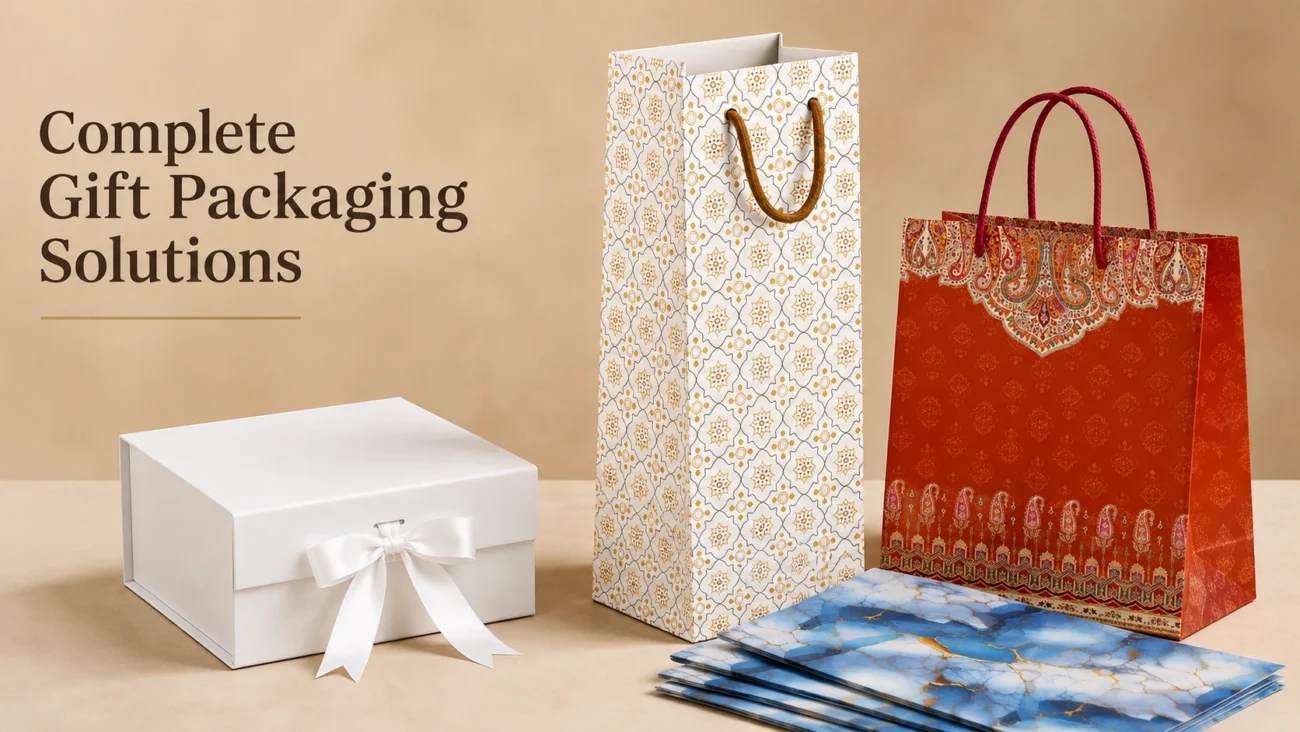
GiftNGreet is a paper packaging manufacturer based in New Delhi, offering a ready-made range of Kraft Paper Carry Bags, Decorative Paper Carry Bags, and Solid Color Paper Carry Bags with nylon rope handles, alongside Foldable Magnetic Lid Boxes, wrapping paper sheets, and wine bottle paper bags.
According to the supplied size information, paper bags are available in five sizes, from Nano to Jumbo, while kraft paper bags are available in four sizes, from Nano to Large. Check the current product listings to confirm the available dimensions and designs.
Frequently Asked Questions
There is no single standard size for all paper bags. Dimensions vary by manufacturer and intended use. Small, medium, and large labels are not consistent across suppliers, so always check the actual width, gusset, and height before choosing a bag.
According to the supplied product size information, GiftNGreet paper bags are available in Nano, Small, Medium, Large, and Jumbo sizes. Kraft paper bags are available in Nano, Small, Medium, and Large. Refer to the size charts in this article for the listed dimensions in inches and centimetres.
Paper bag dimensions are commonly written as width × gusset × height, although some suppliers use a different order. Width measures the front of the bag, the gusset indicates its depth, and height measures the bag body from the base to the top edge. Confirm the supplier’s measurement convention before comparing products.
Measure the wrapping paper against the box before cutting. Fold the cut edges neatly, secure the paper with suitable tape, and add the ribbon or tag after wrapping. Testing the method on one gift first can help when preparing a larger batch.
The gusset is the folded side or bottom section that gives a paper bag depth. It determines how much room the bag has for products with thickness, such as books, gift boxes, and product cartons.
Usually, the listed height refers to the bag body and excludes the handles. However, measurement conventions vary between suppliers, so confirm the specifications before placing an order.
Not necessarily. Carrying capacity depends on paper weight, bag construction, base strength, and handle attachment. A larger bag may provide more space without being suitable for a heavier product.
Many shops can cover a large proportion of their sales with three or four carefully selected sizes. The right range depends on the products sold, their dimensions, and their weight. Group products by size and test the largest or heaviest item in each group.
GiftNGreet, a paper packaging manufacturer based in New Delhi, supplies paper gift bags for retail and business buyers. Review the available sizes and product specifications, and confirm quantities and delivery arrangements before placing a bulk order.
Related Reading
- Choosing the Right Gift Box Size for Different Products
- Types of Paper Gift Bags Explained
- Guide to Paper Gift Bags for Retail Businesses
- Common Gift Packaging Mistakes to Avoid
Manufactured in New Delhi
Packaging Designed For Every Occasion
Explore GiftNGreet’s collection of gift boxes, paper gift bags, wrapping paper, and packaging solutions suitable for gifting, retail businesses, celebrations, and everyday presentation.
Looking for packaging solutions? Visit our Contact Us page for retail and bulk enquiries.