
Packaging Insights
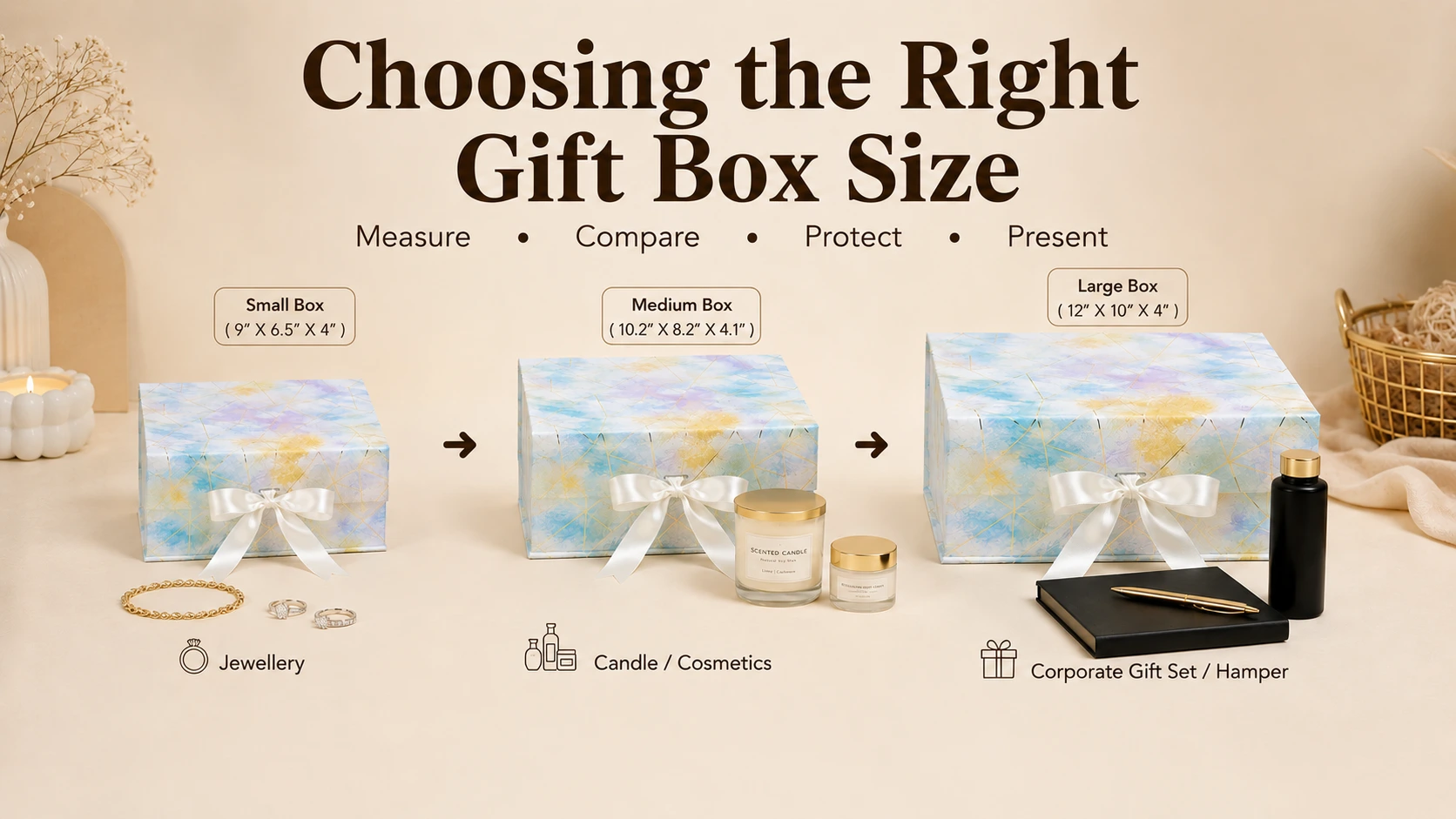
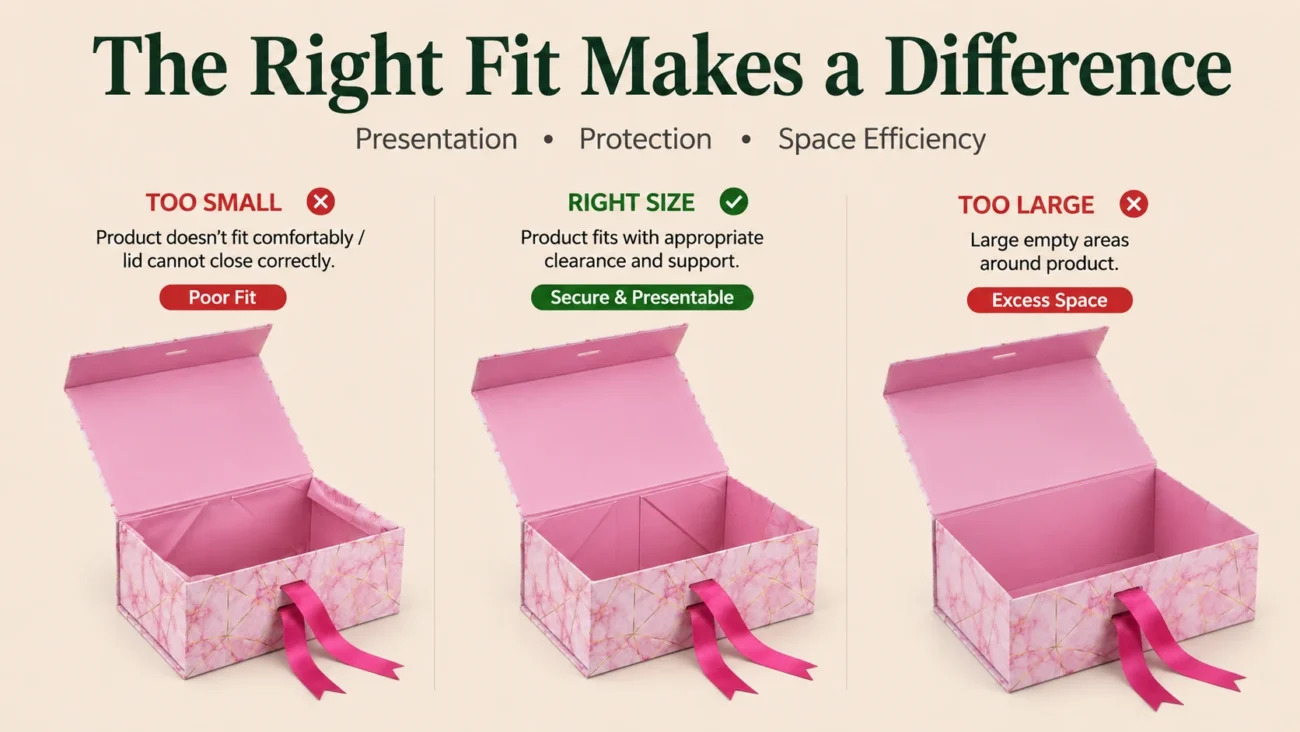
Picking the wrong box size is one of the most common — and most avoidable — packaging mistakes. A box that’s too large leaves products rattling around with poor product protection; a box that’s too small won’t close properly or crushes delicate contents. This gift box size guide walks through exactly how to measure products, understand standard dimensions, and match the right box type to everything from jewellery to festive hampers.
Whether you’re packaging a single item for a personal gift or sourcing boxes in bulk for a retail or corporate gifting program, getting the size right is the foundation of good presentation, protection, and cost efficiency. Box size is only one part of presentation. Structure, finish, product arrangement, and the overall packaging style also influence how the product is perceived. Our guide to how gift boxes improve product presentation explores these factors in more detail.
Quick Takeaways
✔ Measure length, width, and height before choosing a box
✔ Always account for internal dimensions, not just external size
✔ Leave room for cushioning without oversizing the box
✔ Match box type (rigid, foldable, magnetic) to the product
✔ Use standard sizes where possible to reduce cost
Why Gift Box Size Matters
Size affects far more than whether a product fits. The right gift box dimensions directly influence:
- Presentation — a well-fitted box looks intentional and considered, while an oversized one looks careless
- Protection — correctly sized boxes with adequate cushioning prevent shifting, impact damage, and crushing
- Cost — larger boxes cost more to produce and ship, so oversizing wastes money at scale
- Sustainability — excess packaging material and wasted shipping volume both carry an environmental cost
- Customer experience — a snug, well-organized box feels more premium during unboxing than a loose, rattling one
Getting sizing right isn’t just a technical detail — it’s central to how a product is perceived from the moment the box is picked up. Size, structure, colour, and presentation all contribute to the recipient’s initial perception, which is part of why packaging matters for first impressions in gifting.
How to Measure a Product for a Gift Box
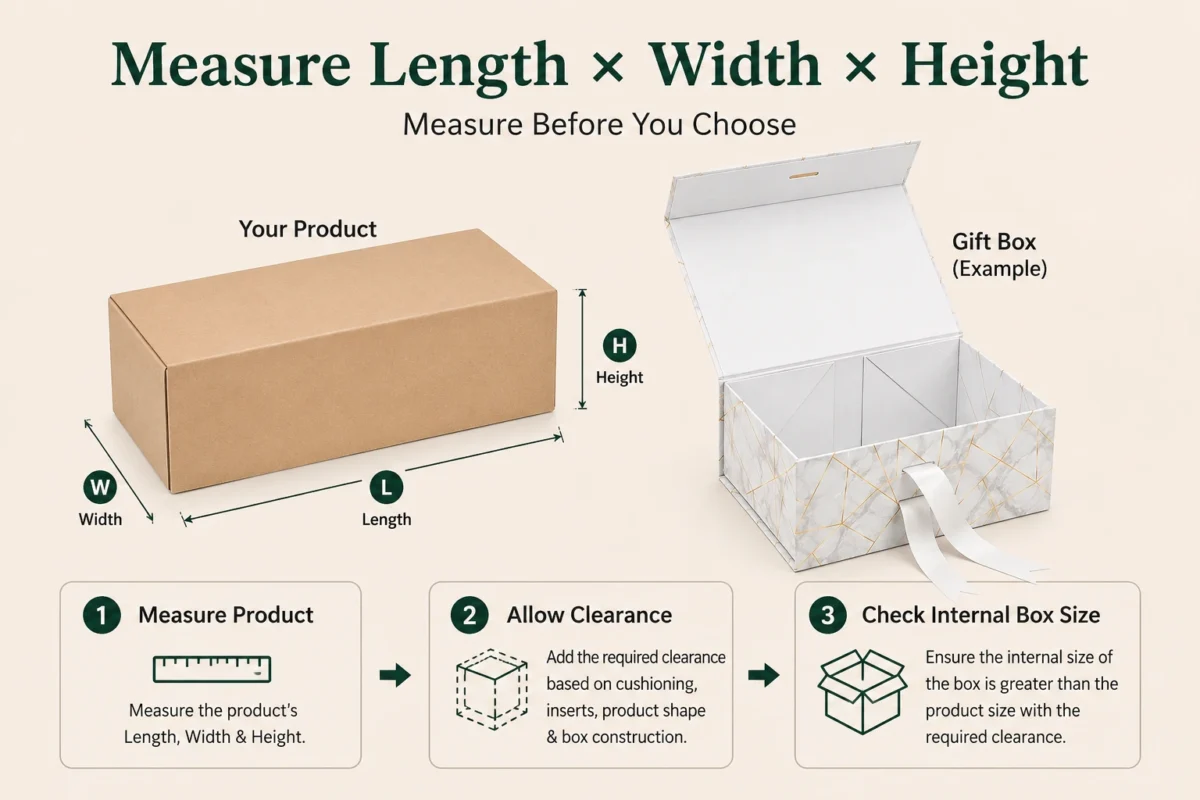
Before choosing a box, it’s essential to know exactly how to measure a product for a gift box. Follow these steps for an accurate fit:
- Measure length, width, and height of the product at its widest points in each direction
- Include any attachments or extensions — handles, ribbons, or protruding parts — in your measurements
- Measure irregular items at their largest cross-section, not just their average size
- Account for multiple items by measuring the full footprint when items are arranged together, not just one piece alone
- Add clearance space — a general guideline is to add roughly 1–2 cm in each dimension for cushioning and ease of closing
- Round up, not down — when a measurement falls between two standard sizes, size up rather than forcing a tight fit
Recording these product dimensions before browsing box options prevents the common problem of choosing a box that looks right but doesn’t actually fit once the product is inside.
Understanding Gift Box Dimensions
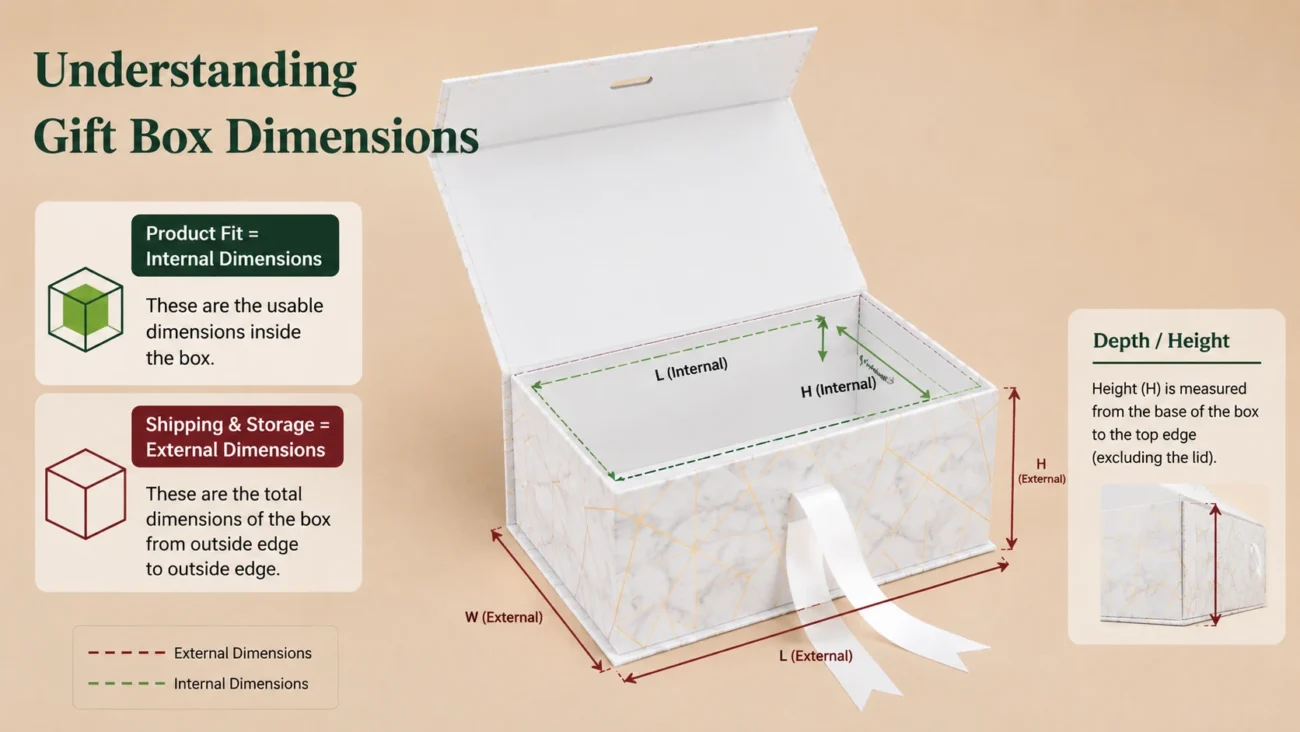
Gift box dimensions are typically listed as length × width × height, but it’s important to understand the difference between external and internal measurements.
External Dimensions
This is the outer size of the box, which matters for shipping, shelf space, and stacking.
Internal Dimensions
This is the usable space inside the box after accounting for wall thickness, lids, and lining — the number that actually determines whether your product fits. Always check internal dimensions rather than relying on external size alone, since board thickness can meaningfully reduce usable space, especially in rigid boxes.
Depth Considerations
Height (or depth) is often the most overlooked dimension. Always measure a product standing in its natural resting position, and account for any lid clearance needed to close the box without pressing down on the contents.
Standard Gift Box Sizes
Using standard gift box sizes where possible helps reduce costs and lead times compared to fully custom options. While exact naming varies by manufacturer, most suppliers offer sizing across a few general categories:
- Small — suited to cosmetics, small stationery sets, and compact gift items
- Medium — suited to mugs, candles, books, and mid-sized gift sets
- Large — suited to apparel, multi-item gift sets, and small hampers
Choosing from standard sizing whenever a product allows is one of the simplest ways to manage a gift packaging size guide for a business with mul tiple product lines. Once you’ve measured the product and identified the required dimensions, compare those measurements with ready-made gift boxes in different sizes to find the closest suitable fit.
How to Choose Gift Box Size by Product Type
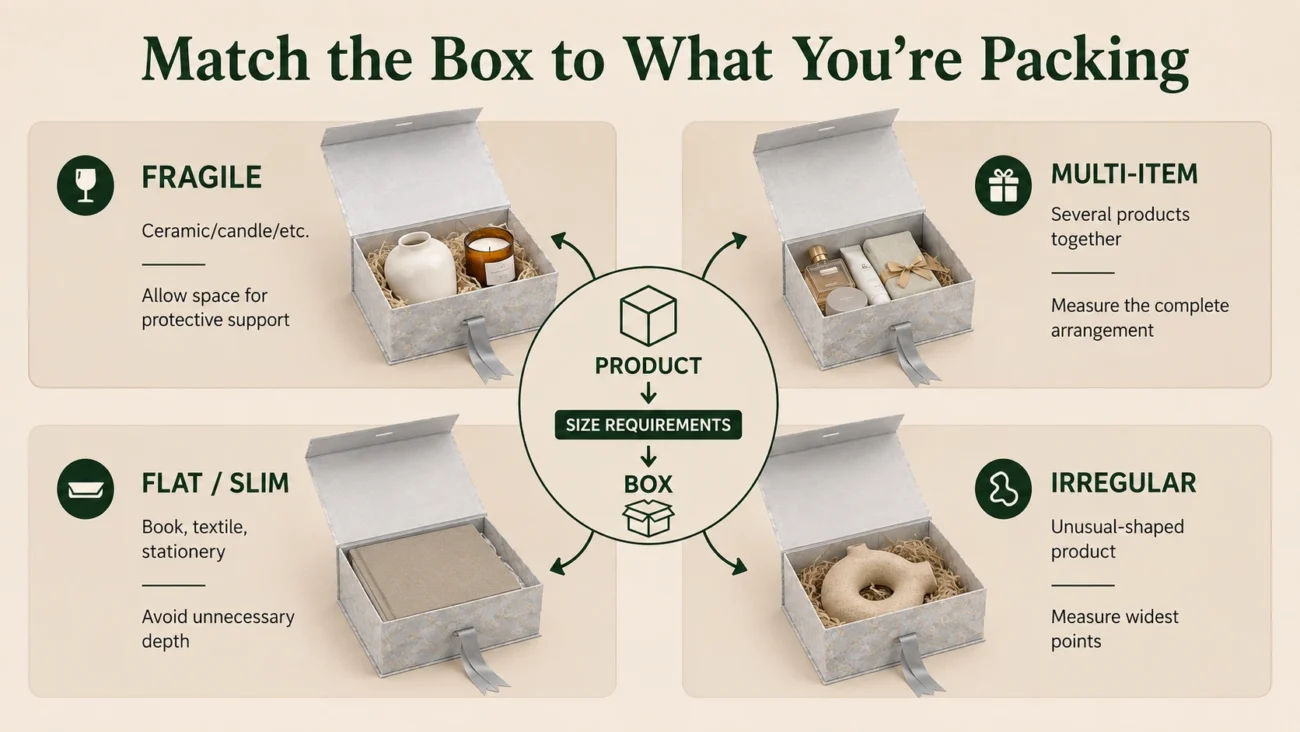
Knowing how to choose gift box size starts with understanding what each product actually needs — protection, presentation, or both.
- For Fragile Items – Prioritize a slightly larger internal size to allow for cushioning, with a rigid or reinforced box style for maximum protection.
- For Multiple Items – Choose a box sized to the combined footprint of all items when arranged neatly, plus space for dividers or inserts to keep them separated.
- For Flat or Slim Products – Choose a shallow box that closely matches the product’s height to avoid excess empty space that allows shifting.
- For Irregular Shapes – Measure at the largest point in each direction, and consider custom inserts or a custom box if standard sizing leaves too much unused space.
Product requirements are important, but the occasion can also influence packaging style and presentation. Our guide to choosing gift packaging for different occasions covers birthdays, weddings, festivals, corporate gifting, and other common uses.
Gift Boxes for Different Products
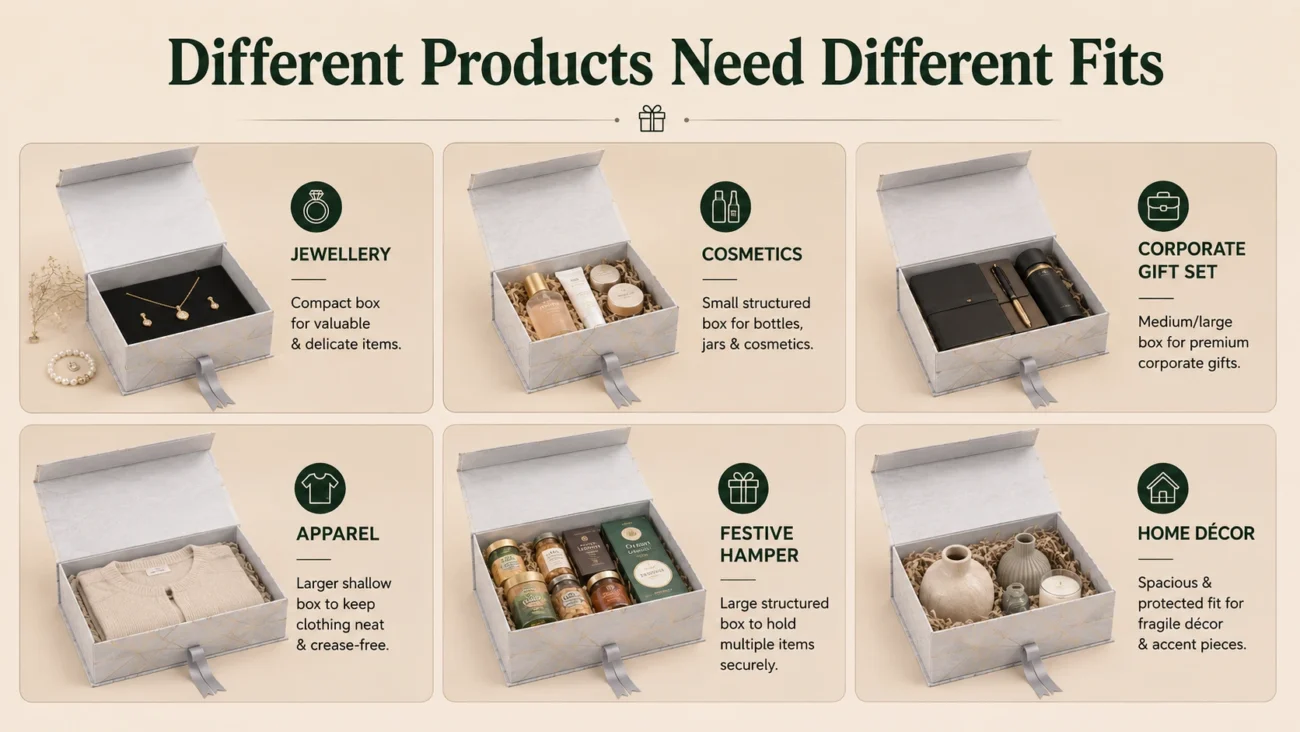
Different gift boxes for different products call for different sizing priorities. Here’s how to approach some of the most common categories:
- Jewellery – Compact, shallow boxes with internal padding or a foam/velvet insert to hold pieces securely in place.
- Corporate Gifts – Medium to large boxes sized around the specific item (mugs, drink-ware, stationery sets), often with dividers if the box contains multiple products.
- Festive Hampers – Large or extra-large boxes with enough internal volume for multiple products, plus dividers or fill material to prevent shifting.
- Wedding Gifts and Return Gifts – Small to medium boxes, generally prioritizing presentation alongside a snug fit for smaller keepsake items.
- Cosmetics and Beauty Products – Small to medium boxes shaped to fit bottles, jars, or compact sets, often with fitted inserts to prevent bottles from tipping.
- Bakery and Food Gifting – Shallow, wide boxes sized to product diameter and height, allowing room for a display window or presentation angle if used.
- Home Décor – Larger boxes with reinforced construction and generous cushioning to protect breakable materials like ceramics or glass.
Medium and larger boxes can work for drink-ware, stationery, gift sets, and other business gifting requirements depending on the product dimensions. Buyers sourcing packaging for these applications can explore gift boxes for corporate gifting and business use.
Cushioning and Box Inserts for a Secure Fit
Even a well-measured box needs the right internal support to keep products secure. Depending on the product and packaging setup, additional cushioning materials or inserts may be used to reduce movement inside the box:
- Tissue paper padding — a simple, low-cost way to fill excess space and add a soft presentation layer
- Foam inserts — shaped foam that holds fragile or high-value items firmly in place
- Cardboard dividers — used to separate multiple items and prevent contact damage
- Shredded paper fill — adds volume and cushioning for hampers and multi-item boxes
- Fabric or velvet lining — common in jewellery and premium gift boxes for both protection and presentation
Choosing the right combination of box size and internal support is what actually delivers reliable product protection — box dimensions alone aren’t enough without the right fill.
Choosing the Right Gift Box Type
Box size decisions go hand in hand with choosing the right box type for the product and occasion.
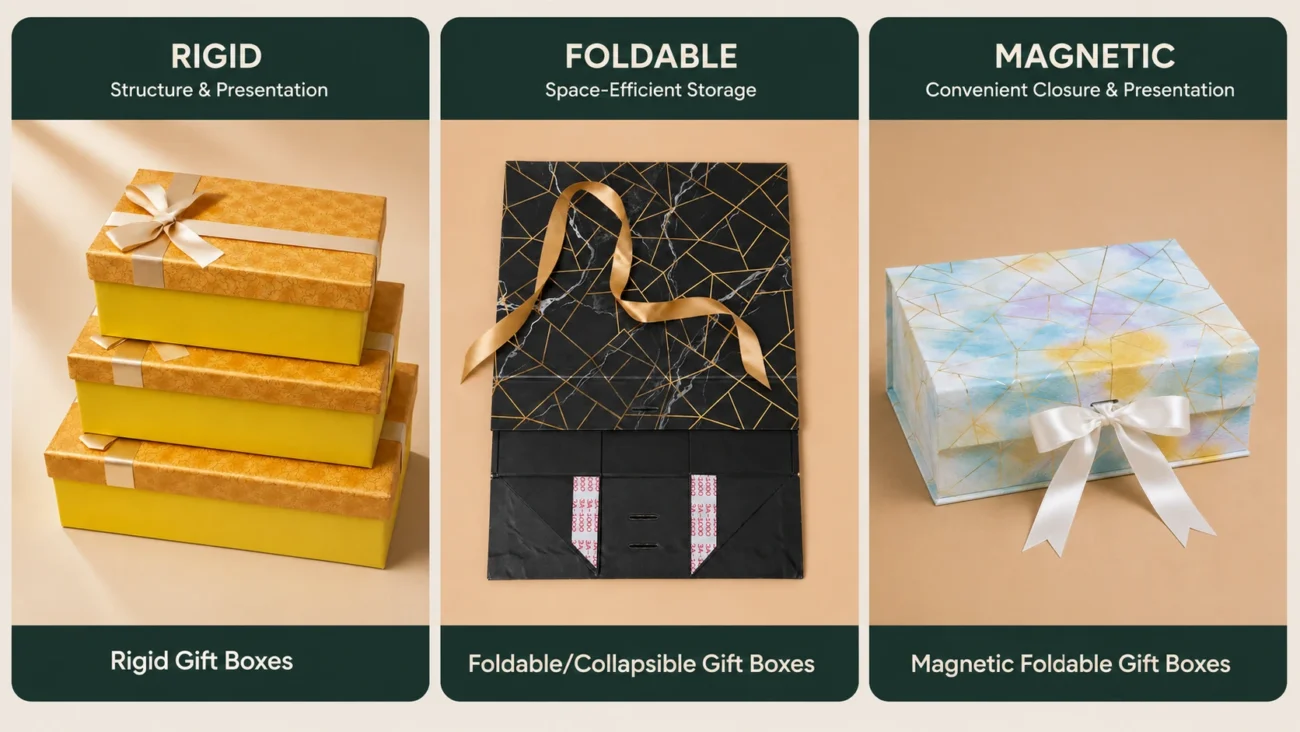
- Rigid Gift Boxes – Built from thick, non-folding board, offering maximum structure and protection — ideal for jewellery, electronics accessories, and higher-value items where a secure, well-fitted internal space matters most.
- Foldable Gift Boxes – Fold flat for storage and shipping, then assemble into shape when needed — a practical, space-saving option for businesses managing multiple sizes across a product range.
- Magnetic Lid Gift Boxes – Feature a magnetic closure for a smooth, premium-feeling open-and-close experience, commonly used for corporate and retail gifting where unboxing experience matters.
For buyers who need structured presentation with convenient storage, foldable magnetic gift boxes can combine a collapsible construction with a neat closure and ready-made decorative presentation.
Common Sizing Mistakes to Avoid
Even experienced buyers run into avoidable sizing errors:
- Choosing a box based on external size alone, without checking internal dimensions
- Underestimating depth, especially for products with lids, handles, or uneven shapes
- Skipping cushioning calculations, leaving no room for padding once the product is measured
- Oversizing “to be safe,” which increases cost and reduces presentation quality
- Using one box size across very different products, leading to a poor fit for some items in the range
- Ignoring combined dimensions when multiple items are packed together in a single box
Box sizing is one of several issues that can affect presentation and usability. See our guide to common gift packaging mistakes to avoid for other problems to consider when selecting packaging.
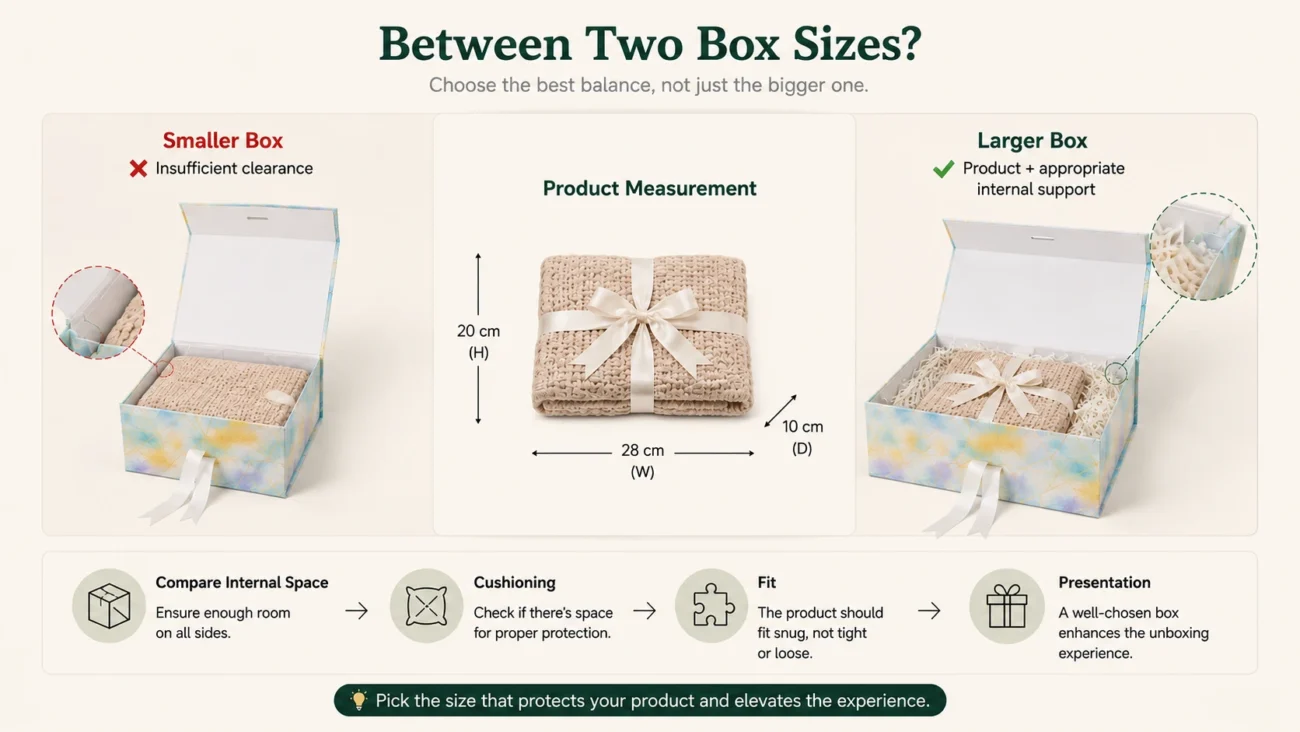
What If Your Product Falls Between Available Gift Box Sizes?
Not every product will match a ready-made box perfectly. When a product falls between available sizes, compare the internal dimensions carefully and choose the closest size that provides enough room without creating excessive empty space.
Consider the product’s shape, weight, orientation, and any additional protective material required. If two sizes could work, evaluate which creates the better balance between product fit, presentation, and practical handling.
Gift Box Size Guide: Quick Reference Table
| Product Type | General Size Category | Suggested Box Style | Internal Support |
|---|---|---|---|
| Jewellery | Extra Small | Rigid-style box | Depending on product |
| Cosmetics | Small | Rigid / Magnetic | May require support |
| Mugs / Candles | Medium | Rigid / Foldable | Protective material |
| Corporate Gift Sets | Medium–Large | Magnetic / Rigid | Depends on contents |
| Apparel | Large | Foldable | Tissue paper |
| Festive Hampers | Large–Extra Large | Structured box | Fill / dividers as needed |
| Home Décor | Product-dependent | Structured box | Protective cushioning |
Why Choose GiftNGreet
is a paper packaging manufacturer based in New Delhi, offering ready-made gift boxes and other paper packaging solutions for retail customers and bulk buyers. The gift box range includes decorative options in multiple available sizes and designs for gifting, retail presentation, festive requirements, and business use.
Choosing the right box begins with measuring your product carefully and comparing those measurements with the available internal dimensions. Explore ready-made gift boxes in different sizes to find an option suited to your packaging requirements.
Frequently Asked Questions
Measure the product’s length, width, and height at its widest points, add small clearance for cushioning, and match the result to the closest standard or custom box size.
Measure length, width, and height at the widest points, include any attachments, and add roughly 1–2 cm of clearance in each dimension for cushioning and easy closing.
Most suppliers offer a general range from extra small (jewellery, small accessories) to extra large (hampers, home décor), with small, medium, and large sizes covering everything in between.
Always prioritize internal dimensions, since wall thickness and lining can meaningfully reduce the usable space compared to the box’s external size.
Roll larger sheets rather than folding them to avoid creases, and store smaller pieces flat in a folder or envelope sorted by pattern or occasion.
Measure the combined footprint of all items arranged together, then choose a large or extra-large box with dividers or fill material to keep items separated and secure.
Yes. Correct sizing prevents excess empty space, but cushioning (foam, tissue paper, or dividers) is still needed to protect the product from movement and impact.
Custom boxes are worth it for irregularly shaped products, specific branding requirements, or product lines that don’t fit neatly into standard length-width-height categories.
Yes, magnetic gift boxes are commonly available in standard small, medium, and large sizes, in addition to custom options for specific product lines.
Related Reading
- How Gift Boxes Improve Product Presentation
- Why Packaging Matters: First Impressions in Gifting
- Paper Gift Bags vs Plastic Bags: Which Is Better?
Manufactured in New Delhi
Packaging Designed For Every Occasion
Explore GiftNGreet’s collection of gift boxes, paper gift bags, wrapping paper, and packaging solutions suitable for gifting, retail businesses, celebrations, and everyday presentation.
Looking for packaging solutions? Visit our Contact Us page for retail and bulk enquiries.