
Packaging Insights
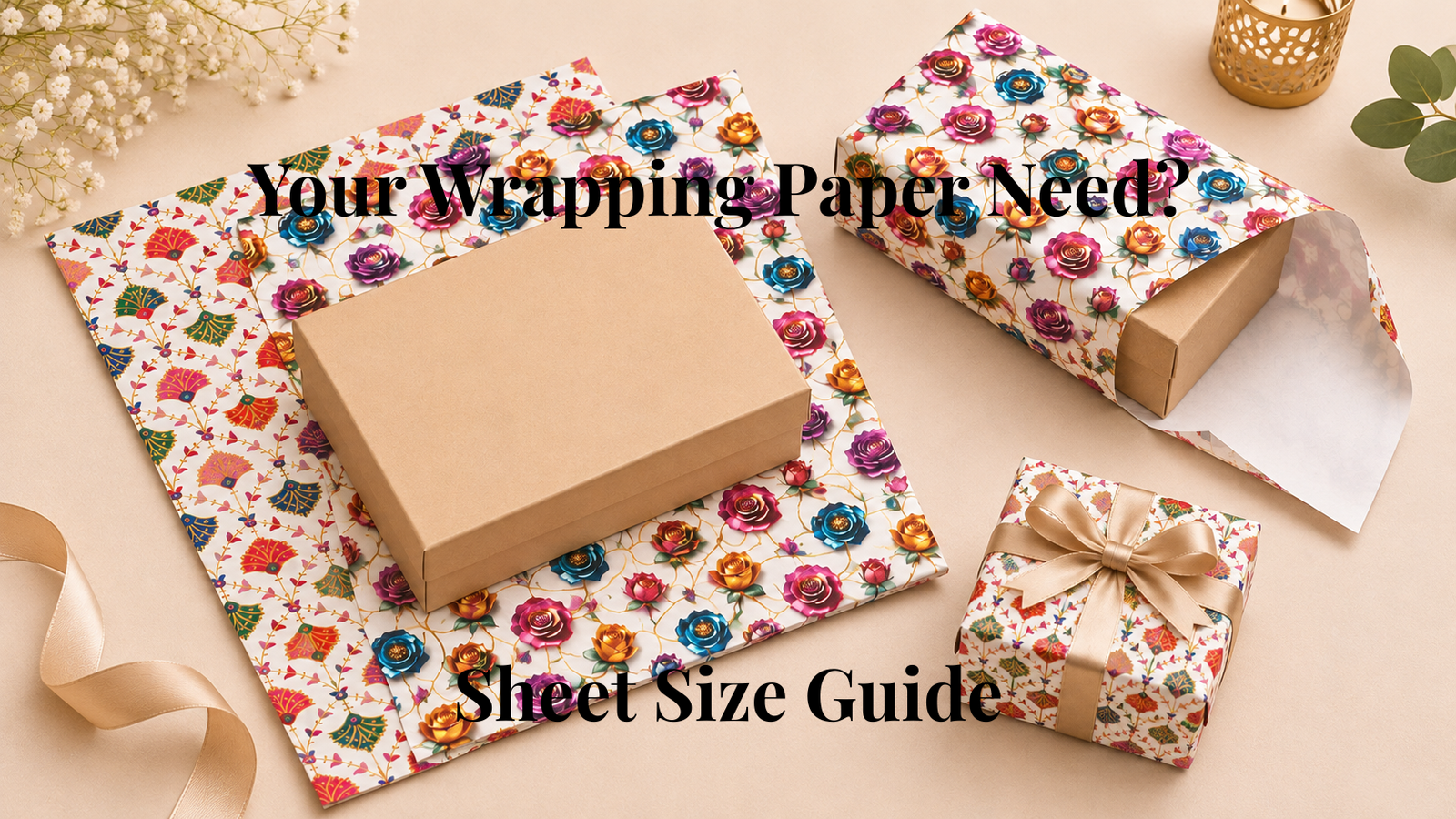
Everyone has experienced it. You pick up a sheet of wrapping paper, hold the gift against it, decide it will probably be enough, and start folding. Then the paper falls short at one corner, or you cut too much and end up with a bulky parcel and a pile of unused off-cuts.
Working out your wrapping paper needs becomes much easier once you know the method. All you need is a tape measure and a minute or two for some simple calculations.
This guide explains how to measure a gift, check whether it will fit on a single flat sheet, estimate how many sheets you need for multiple gifts, and reduce unnecessary waste. It is useful for anyone wrapping a few presents at home, as well as shops and businesses preparing gifts in larger quantities.
The Short Version
- Measure the gift’s length, width and height before choosing your wrapping paper.
- Calculate the paper needed around the gift using: 2 × (width + height) + 3 cm.
- Calculate the paper needed along the gift’s length using: length + height + 4 cm.
- Compare both measurements with your sheet size to check whether one sheet is sufficient.
- If the gift does not fit, consider a larger sheet, two joined sheets or a suitable gift bag.
- When wrapping multiple gifts, estimate the number of sheets required and allow an additional 10–15% for mistakes and off-cuts.
- GiftNGreet wrapping paper is supplied in one sheet size in packs of 20 flat sheets, so check the listed dimensions before deciding how many packs you need.
Flat Sheets and Rolls: What Changes
Most people think about wrapping paper as a roWrapping paper is commonly sold either as rolls or as flat sheets. Both can be used to wrap gifts, but the way you measure and plan your paper is different.
- Flat sheets have fixed dimensions. You cannot unroll additional paper, so you need to check whether the sheet is large enough for your gift before cutting.
- Flat sheets lie flat. This can make measuring, cutting and folding more straightforward because you do not have to manage the curl of a roll.
- Sheets can work well for small and medium-sized gifts. Books, boxed accessories and other compact products may fit on a single sheet, depending on their dimensions.
- Larger gifts require more planning. If a gift is too large for one sheet, you may need a larger format, two sheets or an alternative such as a gift bag.
With flat sheets, the main questions are: What sheet size will fit my gift, and how many sheets will I need? The following steps help you answer both.
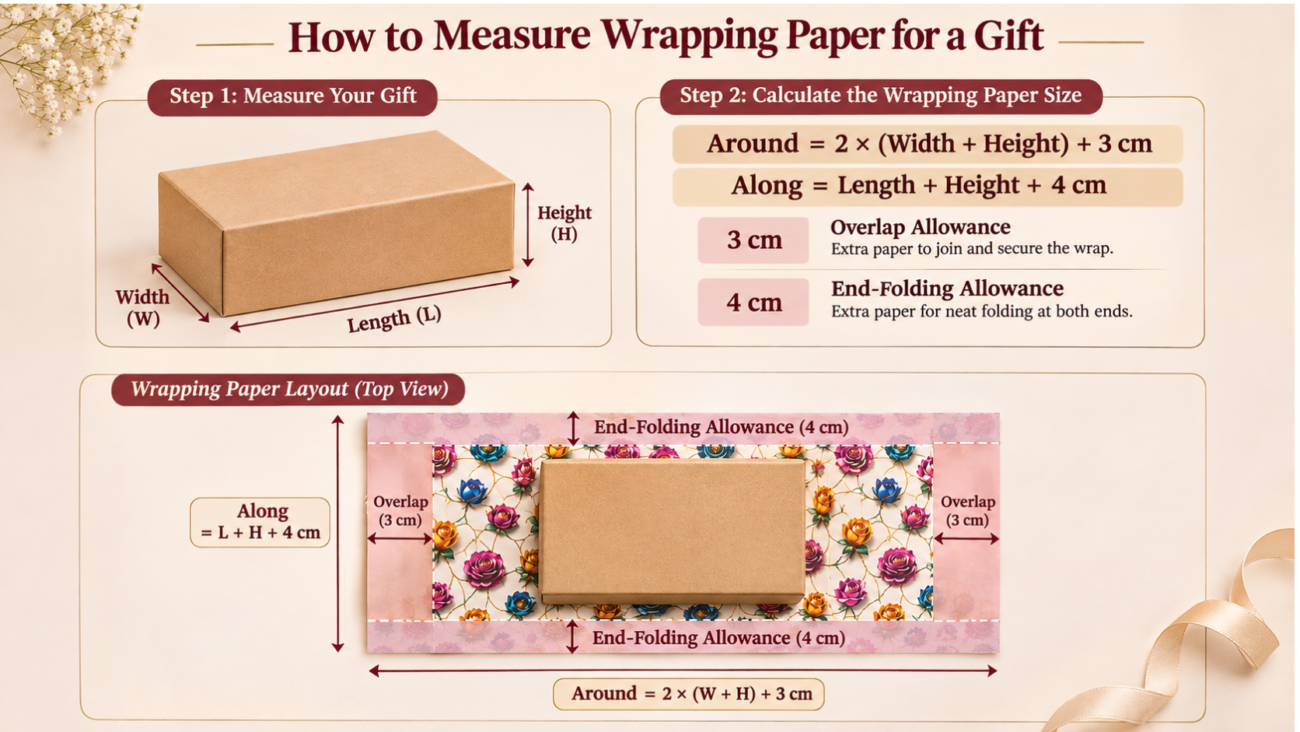
How to Measure Wrapping Paper for a Gift
This is the method that works for most boxes and box-shaped gifts such as books and boxed products. You’ll need a tape measure.
- Step 1: Measure the Gift in Three Directions: Measure the gift’s length (the longest side), width (the next longest), and height (how tall it stands). Write them down. If the gift is already in a box, measure the box. Write down all three measurements in centimetres. If the gift is already packed in a box, measure the outside of the box because that is the surface the paper must cover.
- Step 2: Work Out the Paper Needed Around the Gift: The paper must go around the gift and overlap slightly where the two edges meet. For a standard box-shaped gift, calculate the required measurement using:
Around = 2 × (width + height) + 3 cm
The additional 3 cm allows the paper edges to overlap so you can secure the seam with tape. - Step 3: Work Out the Paper Needed Along the Gift: The paper must also extend along the gift and leave enough material at both ends to fold them neatly. Use this formula:
Along = length + height + 4 cm
The additional allowance provides material for folding the ends. The exact amount needed can vary slightly with the gift’s shape, the folding method and the thickness of the paper. - Step 4: Compare Your Measurements With the Sheet: Your sheet needs to accommodate both calculated dimensions: Around × Along. Compare those figures with the actual sheet dimensions listed by the supplier. You can rotate the sheet to see whether the measurements fit in the opposite direction. If either measurement exceeds the available sheet size, one sheet may not be sufficient. Consider a larger sheet or a different packaging option rather than cutting the paper and discovering it is too small.
The Formulas at a Glance
| Measurement | Formula |
|---|---|
| Paper needed around the gift | 2 × (width + height) + 3 cm |
| Paper needed along the gift | length + height + 4 cm |
These formulas are intended for standard box-shaped gifts wrapped with the main seam underneath and the ends folded in. Use them as a starting point, then check the fit physically before cutting, especially when working with an unfamiliar sheet size.
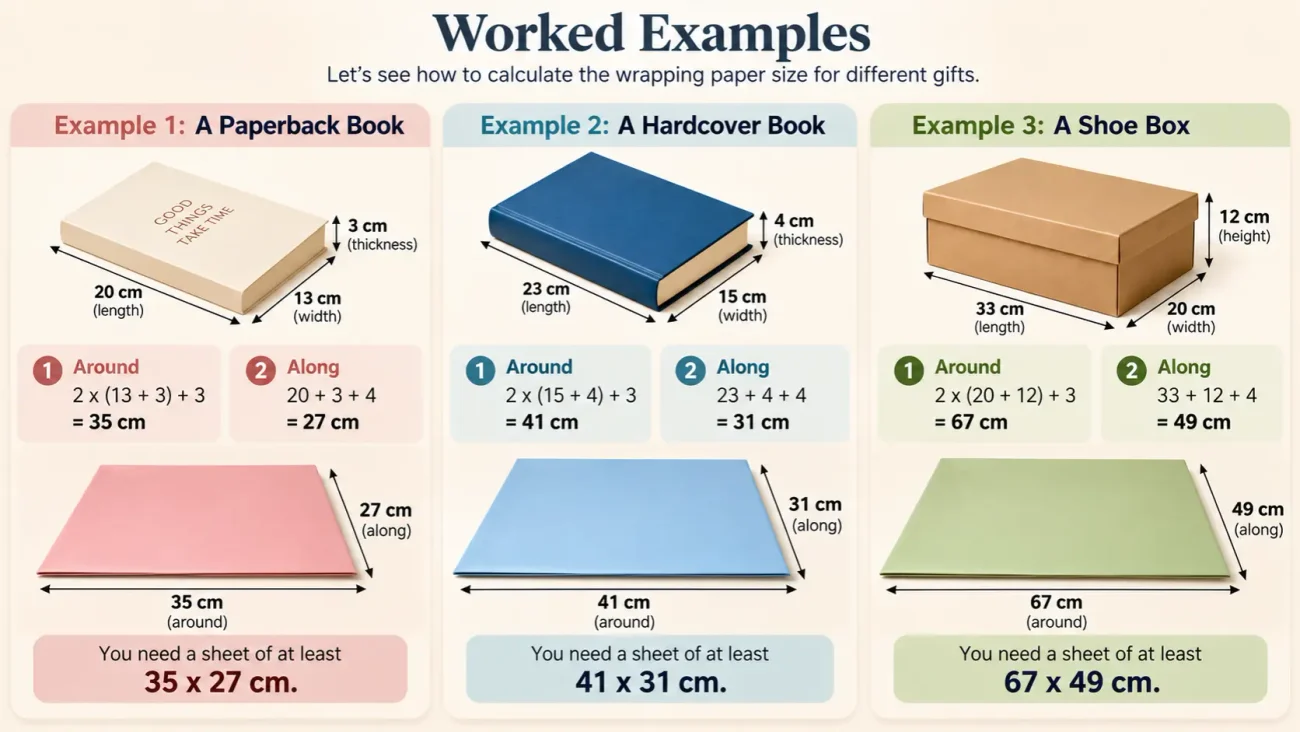
Wrapping Paper Sheet Size Guide: Common Gifts
The table below provides approximate sheet measurements for several common gifts, using the same formulas. These are examples rather than measurements of specific products, so check your own items before cutting.
| Gift | Approximate gift size (L × W × H) | Minimum calculated sheet size |
|---|---|---|
| Small jewellery box | 8 × 8 × 4 cm | 27 × 16 cm |
| Paperback book | 20 × 13 × 3 cm | 35 × 27 cm |
| Hardcover book | 23 × 15 × 4 cm | 41 × 31 cm |
| Mug in a box | 12 × 12 × 12 cm | 51 × 28 cm |
| Boxed shirt | 30 × 25 × 5 cm | 63 × 39 cm |
| Shoe box | 33 × 20 × 12 cm | 67 × 49 cm |
Compare these measurements with the wrapping paper sheet size listed for the product you intend to buy. Sheet dimensions vary between suppliers, so do not assume that every sheet will accommodate the same gifts.
Smaller gifts may allow you to cut one sheet into multiple pieces, depending on the sheet dimensions and the wrapping method. Larger boxes generally require more paper, so check the measurements before purchasing or cutting.
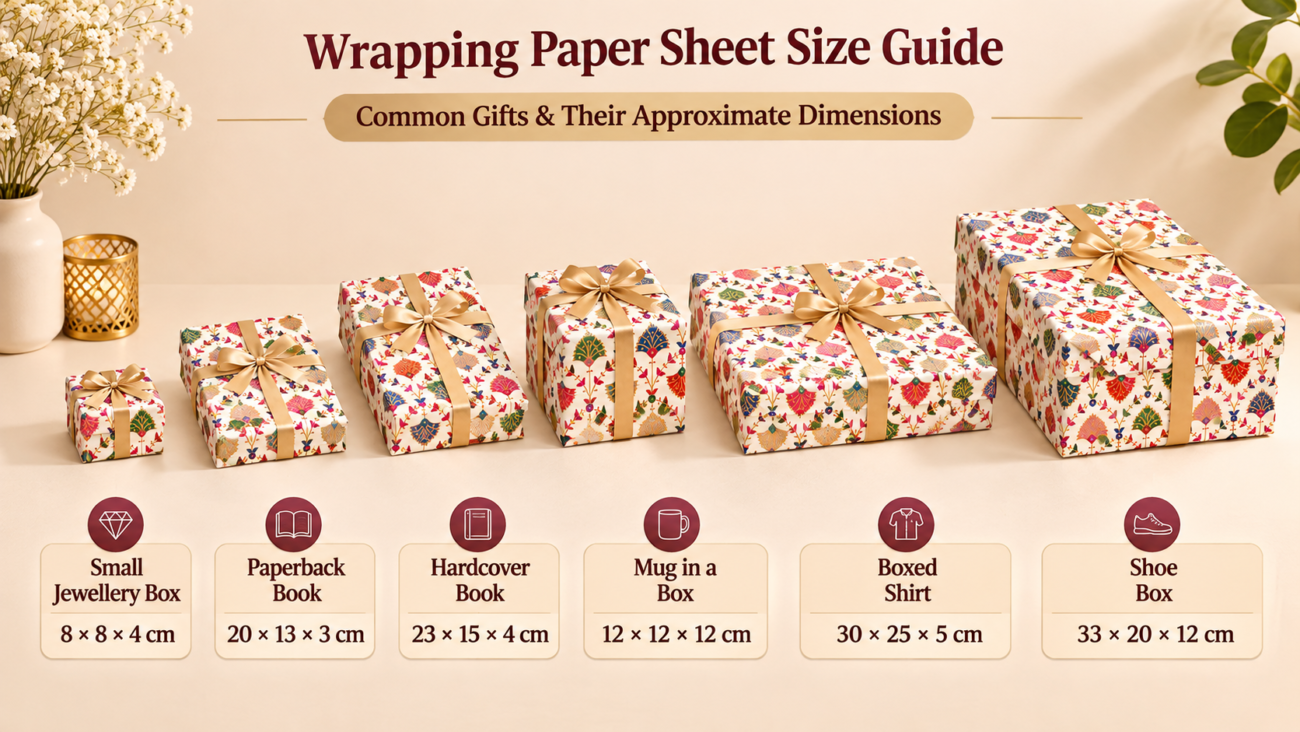
The No-math Method:
If you prefer not to calculate the measurements, a simple physical test can help you check whether a sheet is large enough.
- Place the gift in the center of the sheet. Position its longest side along the sheet’s longer direction.
- Bring one edge over the gift. Check whether the paper reaches approximately the middle of the top surface.
- Bring the opposite edge across. The two edges should overlap by about 2–3 cm so you can secure them with tape.
- Check both ends. Make sure there is enough paper extending beyond the gift to fold the ends neatly.
- Adjust if necessary. If the paper falls short, rotate the gift or try a larger sheet.
This method is particularly useful for checking your calculations before cutting. It can also help with gifts that are not perfectly rectangular, although irregular shapes may require additional paper.
What About Awkward Gifts?
Not every gift has straight edges and a convenient rectangular shape. Some items are difficult to wrap neatly with a flat sheet, even when you have measured them carefully.
Consider these alternatives:
- Place the item in a box first. A box creates a more predictable shape that is easier to measure and wrap.
- Use a gift bag with tissue paper. This can be a practical option for soft, irregular or tall items.
- Wrap several flat items together. Books or small boxes can sometimes be arranged into one parcel, provided the combined dimensions are suitable.
- Allow extra paper for rounded shapes. Curved surfaces can make folding and securing the paper more difficult than wrapping a rectangular box.
The aim is to choose a method that gives you a neat result without wasting paper or making the wrapping unnecessarily complicated.
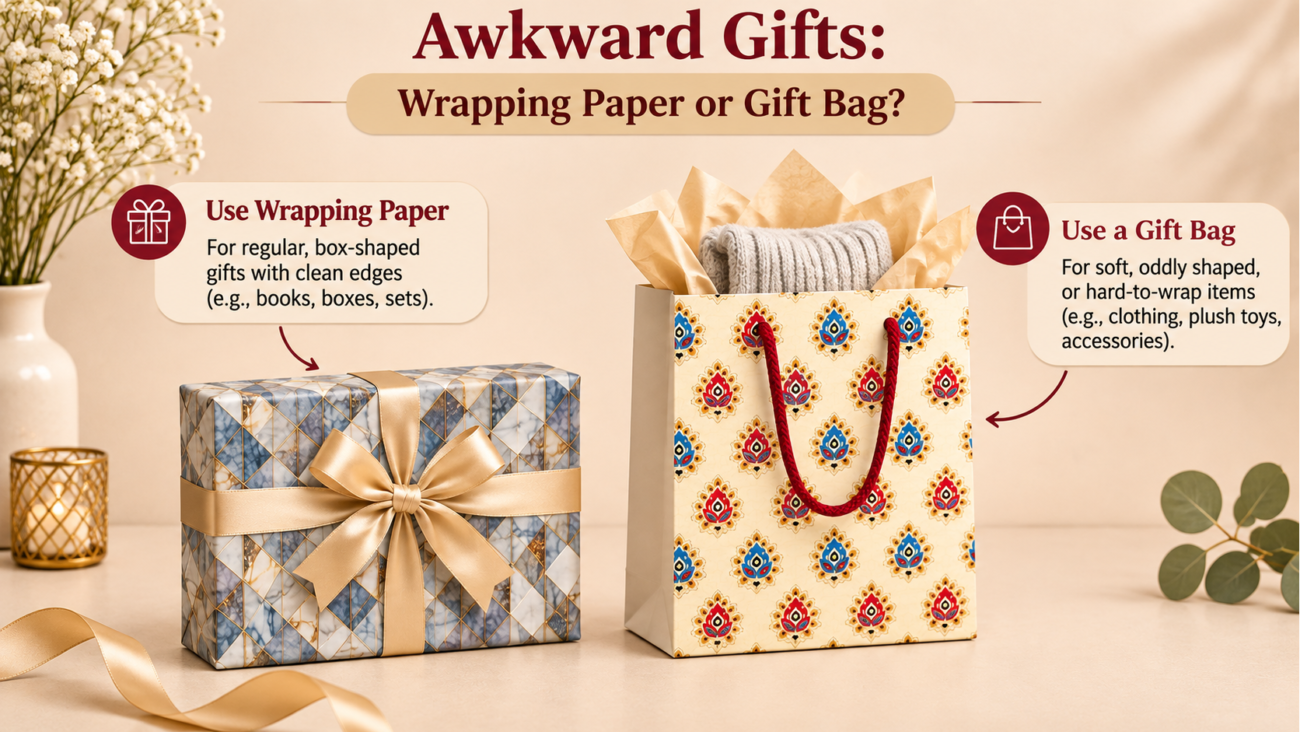
Wrapping Clothes, Scarves and Other Soft Gifts
Soft gifts do not have fixed edges, so measuring them directly can be difficult. The simplest approach is to give the item a more regular shape before calculating the paper required.
- Fold the item into a neat rectangle. Keep the folds as flat as possible.
- Hold the shape in place. Use a suitable temporary fastening or a piece of card to prevent the item from unfolding while you measure it.
- Measure length, width and height. Treat the folded item like a box and apply the same two formulas.
- Allow for thickness and movement. Soft or bulky fabrics may expand after you release them, so leave enough room to fold the paper comfortably.
If the fabric is particularly bulky or will not hold its shape, a gift bag with tissue paper may provide a neater result than trying to wrap it tightly.
Choosing the Right Wrapping Paper Sheet Size
Choosing the right sheet size helps you avoid wasted paper, incomplete folds and unnecessary repacking. Before buying wrapping paper, consider the size of your most common gifts and how you plan to wrap them.
A few practical checks can help:
- Check the listed dimensions. Look at the actual sheet measurements rather than relying on a product name or photograph.
- Consider your most common gifts. If you usually wrap books, small boxes or accessories, check whether the sheet can accommodate those items comfortably.
- Allow for pattern alignment. Stripes and directional prints may need extra paper to keep the design straight across the parcel.
- Consider the folding method. A sheet that fits the basic measurements may still need a little additional room depending on the shape of the gift and how you fold the ends.
Once you have established the right size, you can focus on presentation. Our guide to matching wrapping paper with gift boxes through complementary colours and patterns explains how to coordinate the two without making the overall presentation look cluttered.
GiftNGreet Wrapping Paper: One Sheet Size, Packs of 20
Gift-N-Greet wrapping paper is available in one sheet size, supplied in packs of 20 flat sheets. This makes purchasing straightforward, but it also means checking the dimensions is particularly important.
Before ordering, compare the sheet dimensions listed on the product page with the measurements you calculated for your gift.
- If the gift fits: One sheet can be used for one gift, provided the actual wrapping test confirms sufficient overlap and folding allowance.
- If the gift is small: You may be able to cut one sheet into two or more pieces, depending on the dimensions and the amount of paper each gift requires.
- If the gift is too large: Consider using a suitable gift bag or box rather than joining sheets, which can create visible seams and make wrapping more difficult.
- If you are wrapping many gifts: Estimate the number of usable sheets required before deciding how many packs to order.
How Many Packs Do You Need?
The table below assumes that each gift requires one complete sheet and includes an additional 10% allowance for mistakes and off-cuts. Each pack contains 20 sheets, and pack quantities are rounded up to whole packs.
| Gifts to wrap | Sheets including buffer | Packs of 20 |
|---|---|---|
| 10 | 11 | 1 |
| 20 | 22 | 2 |
| 40 | 44 | 3 |
| 60 | 66 | 4 |
| 100 | 110 | 6 |
| 200 | 220 | 11 |
If your gifts are small enough to share a sheet, calculate how many usable pieces you can cut from each sheet before estimating the number of packs. Remember that the pieces must still be large enough to wrap the gifts properly.
For businesses purchasing larger quantities, it is useful to monitor how many sheets are used during a typical week. This provides a more realistic estimate for future orders than relying on guesswork.

How Much Wrapping Paper to Buy When You’re Wrapping Many Gifts
Wrapping multiple gifts for a shop, event or festive season requires a little more planning. Buying too little can interrupt packing, while ordering too much can leave you with unused stock.
Use this simple process to estimate your requirements:
- List the gifts: Record the types of gifts you need to wrap and the quantity of each.
- Calculate the required sheet size: Measure each type of gift and use the formulas from Part 1.
- Estimate sheets per gift: Decide whether each gift needs a full sheet or whether smaller gifts can share one sheet.
- Calculate the total: Divide the number of gifts by the number of gifts you can wrap per sheet, accounting for different sizes.
- Add a buffer: Include approximately 10–15% extra to cover mistakes, off-cuts and last-minute additions.
For shops and businesses ordering packaging in larger quantities, our guide to sourcing gift packaging in bulk and planning orders around samples, quantities and supplier terms provides additional guidance.
Tips for Wasting Less Paper
A few simple habits can help you use wrapping paper more efficiently, especially when wrapping several gifts in one session.
- Measure before cutting. A quick measurement can prevent you from ruining a sheet that is too small.
- Use double-sided tape where suitable. It can help create a neater seam without requiring excessive overlap.
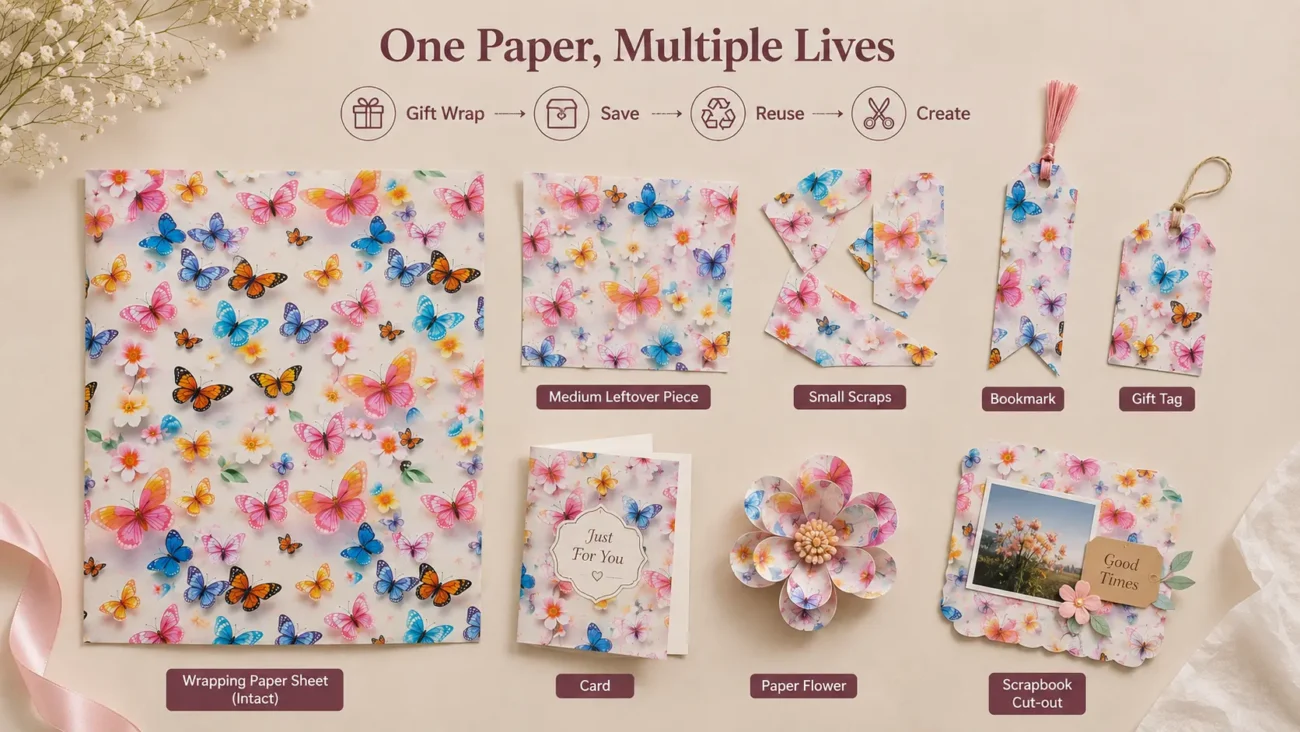
- Keep useful off-cuts. Smaller pieces may work for small boxes, tags or craft projects. Explore our guide to creative ways to use leftover wrapping paper beyond gift wrapping for more ideas.
- Match the sheet to the gift. Avoid using a large sheet for a small item when a smaller piece will do.
- Plan around repeated sizes. When wrapping many similar gifts, measure one item first and use it as a reference for the others.
Reducing waste does not mean cutting every sheet as tightly as possible. Leave enough paper for secure seams and neat folds so you do not end up using another sheet to correct a mistake.
Common Wrapping Paper Mistakes
Even with the right paper, a few common errors can make wrapping harder than it needs to be.
- Guessing instead of measuring: The sheet may fall short once you start folding.
- Forgetting the gift’s height: Taller boxes need more paper around their sides and at the ends.
- Cutting too close to the required measurements: Insufficient overlap can make it difficult to secure the seam.
- Ignoring pattern direction: Directional prints may look uneven if the paper is not positioned carefully.
- Skipping the extra allowance for large batches: A small number of mistakes can leave you short of paper when wrapping many gifts.
The easiest way to avoid these problems is to measure first, test the sheet against the gift and calculate your quantity before starting a large wrapping session.
Measure Once, Wrap Once
Wrapping becomes easier when you know what you need before you start. Measure the gift, calculate the two dimensions, compare them with your sheet and check the fit before cutting.
When preparing multiple gifts, estimate how many usable pieces each sheet can provide and include a reasonable allowance for mistakes. A few minutes of planning can save paper, reduce unnecessary costs and prevent the frustration of discovering that a corner will not close.
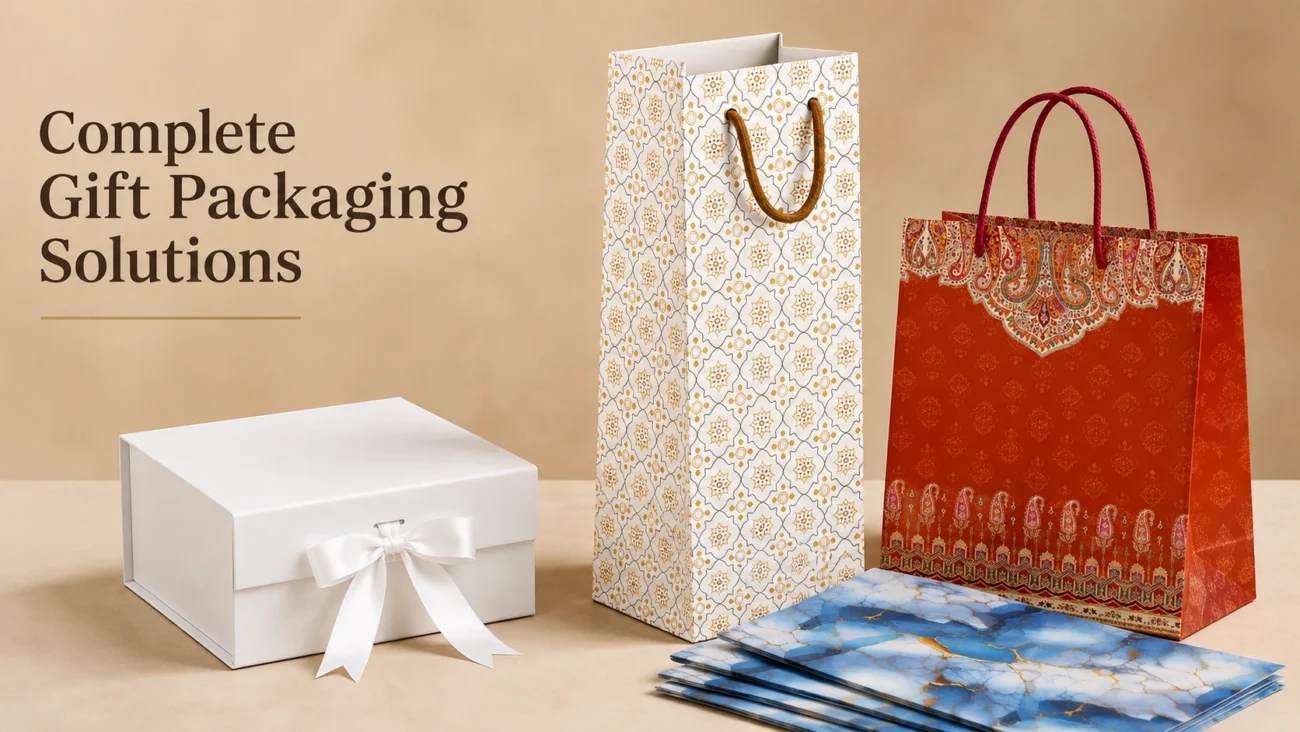
GiftNGreet is a paper packaging manufacturer based in New Delhi, offering wrapping paper sheets in a range of printed designs, supplied in one sheet size and packs of 20. Its ready-made packaging range also includes paper gift bags, kraft paper bags, Foldable Magnetic Lid Boxes and wine bottle paper bags. Check the product pages for current availability and specifications.
Frequently Asked Questions
Measure the gift’s length, width and height. For a standard box-shaped gift, estimate the paper needed around it using 2 × (width + height) + 3 cm, and the paper needed along its length using length + height + 4 cm. Compare both measurements with your sheet size before cutting.
Measure the gift in three directions, then use the two formulas to calculate the approximate sheet dimensions required. Place the gift on the sheet to check the overlap and ensure there is enough paper to fold both ends neatly.
A paperback measuring approximately 20 × 13 × 3 cm needs a sheet of at least 35 × 27 cm according to the guide’s formula. A hardcover measuring 23 × 15 × 4 cm needs approximately 41 × 31 cm. These are estimates, so check the fit before cutting.
Allow approximately 2–3 cm of overlap along the main seam. This should provide enough material to secure the paper with tape without creating an unnecessarily bulky finish.
Height affects both the amount of paper needed around the box and the amount required to fold its ends. As a result, a tall shoe box may require considerably more paper than a relatively flat book, even if their lengths are similar.
Allow approximately 10–15% extra beyond your calculated requirement to account for mistakes, off-cuts and last-minute additions. The appropriate buffer depends on the complexity of the gifts and your wrapping experience.
Flat sheets have fixed dimensions and lie flat, which can make measuring and folding more straightforward. Rolls allow you to unroll the length you need, but the paper may curl and require more handling.
GiftNGreet wrapping paper is supplied in one sheet size, in packs of 20 flat sheets. Check the product page for the listed dimensions and compare them with your gift measurements before ordering.
You can compare paper packaging manufacturers, wholesalers and packaging suppliers based on their available designs, sheet dimensions, minimum order quantities and delivery terms. GiftNGreet, based in New Delhi, supplies wrapping paper sheets for retail and business buyers. You can use the Contact Us page to enquire about available quantities and designs, subject to confirmation of the current ordering terms.
Related Reading
- How to Match Wrapping Paper with Gift Boxes
- Creative Ways to Use Wrapping Paper Beyond Gifts
- Paper Bag Size Guide: How to Choose the Right Size for Every Product
- Choosing the Right Gift Box Size for Different Products
Manufactured in New Delhi
Packaging Designed For Every Occasion
Explore GiftNGreet’s collection of gift boxes, paper gift bags, wrapping paper, and packaging solutions suitable for gifting, retail businesses, celebrations, and everyday presentation.
Looking for packaging solutions? Visit our Contact Us page for retail and bulk enquiries.